Key takeaways
- A GTM strategy framework does not need 20 layers. Three earn you pipeline: a brain and a channel, an ICP filter, and a way to replicate yourself.
- The 20-layer GTM infographic is click-bait. Every data point gets relabeled a 'layer' so the stack looks mandatory and you feel unqualified to start.
- Start manual. Write your own messages and call people before you buy a single tool. Automation copies a motion that works, it cannot create one.
- Add a layer only when the one beneath it is genuinely saturated. That single rule replaces the entire stack diagram.
- More data does not mean more replies. Past a few relevant signals you hit diminishing returns, the same commodity-data war that stopped moving alpha in finance.
In This Post
- How many layers does a GTM strategy framework actually need?
- The 20-layer GTM strategy myth
- Minimum Viable GTM: a go-to-market framework in 3 layers
- The optional layer most teams add too early: data
- Why more data does not mean more replies
- The one rule that replaces the 20-layer GTM template
- What earning each layer looks like in practice
- Your minimum viable GTM checklist
- The bigger picture
- How Cronical collapses the data layers
- Methodology
- FAQ
- Related reading
How many layers does a GTM strategy framework actually need?
Three, to start. A brain and a channel, an ICP filter, and a way to replicate yourself. Everything else the infographics sell you is optional, and you add it later, one piece at a time, only after the current setup stops keeping up.
That answer will feel too small if you have been reading the usual advice. Open any go to market strategy template and you get nine steps, or eleven, or seven whole frameworks stacked on top of each other, all presented as prerequisites you need in place before your first email goes out. None of them tell a first-time founder where the floor is. None give you a rule for when to stop adding.
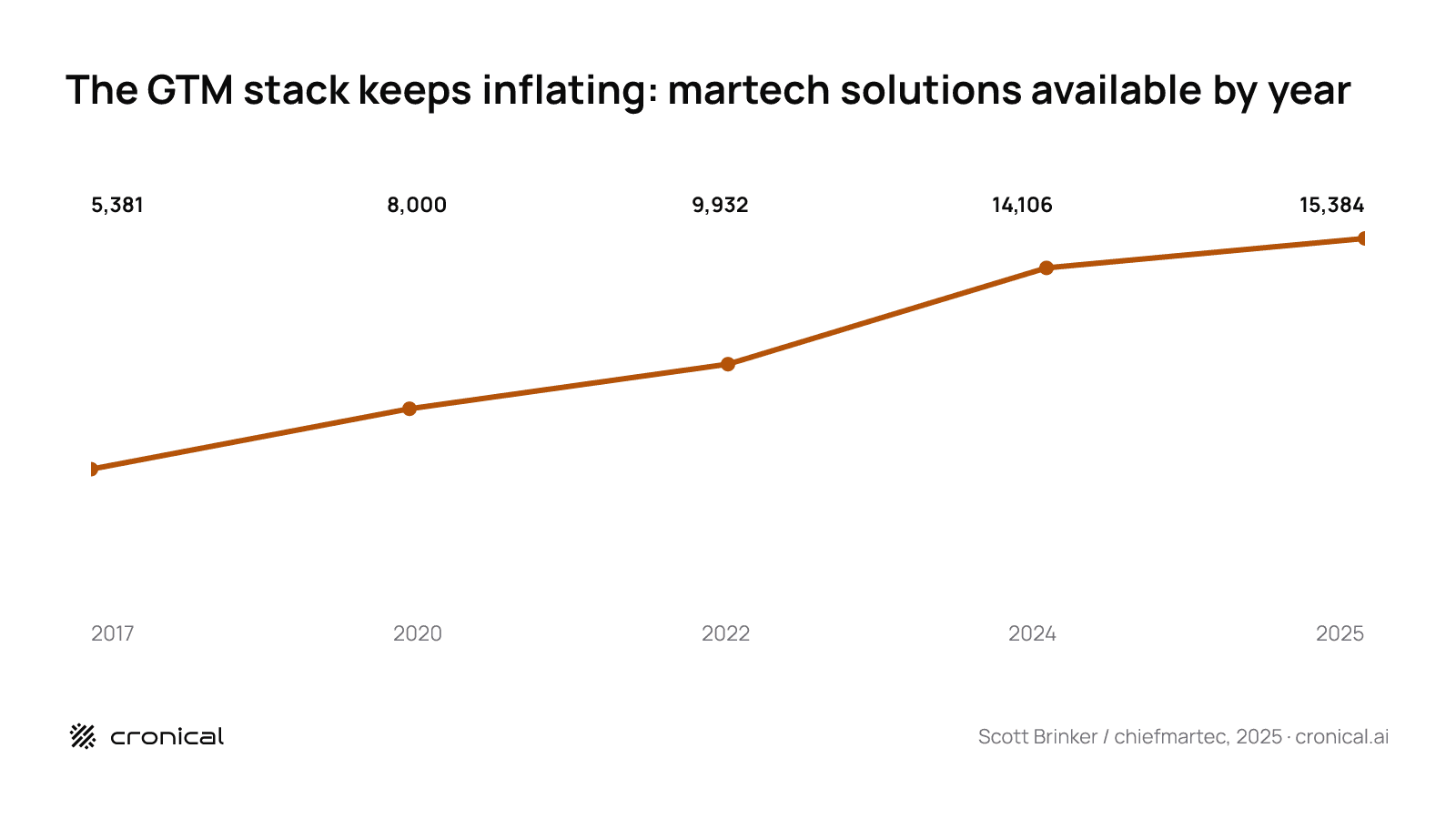
Part of why the stack looks so intimidating is that the menu itself keeps growing. The number of martech tools available climbed from 5,381 in 2017 to 15,384 in 2025, and the count jumped 27.8% in a single year between 2023 and 2024. Every one of those tools has a marketing team telling you it is the layer you are missing.
The searcher looking for a gtm strategy framework wants a structure. That is reasonable. What they get instead is a shopping list dressed up as a strategy, and the effect on someone who has never run outbound before is paralysis. This post gives you the structure without the bloat: the smallest go-to-market that produces real conversations, and the exact trigger for adding each layer after it.
The 20-layer GTM strategy myth
Here is the trick the "layers of GTM" content plays. It takes a single data point, the prospect's phone number, and calls it a layer. It takes their email and calls that a layer. It takes their job title, their company size, their tech stack, their last funding round, and each one becomes its own numbered tier in a diagram that now has twenty of them. Relabeling a data field as a layer implies it is load-bearing, that the tier above cannot function without it. That implication is false, and it is doing a job.
The job is to make you feel behind. A founder staring at a twenty-tier diagram concludes they cannot possibly start alone, which is exactly the feeling that sells a consultant or a platform subscription. The complexity is not an accident or an oversight. It is the product. And a genuinely twenty-layer go-to-market would be so over-engineered that running it would set you back, not ahead. Almost nobody actually runs it, including the people posting the diagram.
You can see the waste in how bought tools get used. Companies use only 49% of the SaaS licenses they pay for, leaving an average of $18M in annual license waste. Half of the stack sits idle. Adding the twelfth layer does not make the first three work better. It makes an invoice.
This is the same failure mode as the spray-and-pray outbound that stopped working: buying rented infrastructure and mistaking it for an edge. If you want the longer argument on why tooling volume is not a moat, we made it in the piece on whether cold outreach is dead. The short version applies here too. The layers are cheap and everyone has them. What is scarce is a person who knows who to talk to and what to say.
Minimum Viable GTM: a go-to-market framework in 3 layers
The honest counter to the twenty-layer diagram is not "do nothing." It is a defined minimum you can grow deliberately. Emery Rosansky, who runs go-to-market at First Round, frames the balance well.
When you're early, the typical advice is to not waste your time on process and structure. I agree that you don't want to over-engineer, but so many founders forgo fundamental, simple processes, and they can really flounder because of that.
Minimum Viable GTM is that fundamental floor. Three layers, ordered by dependency, where each one uses the output of the layer beneath it. You cannot filter for an ideal customer you have not met yet, and you cannot automate a message that does not yet get replies. Reorder the layers and the model breaks, which is how you know it is a sequence and not a checklist.
Start at the floor, earn every layer
Minimum Viable GTM
- 01
Layer 1: a brain and a channel
You, and one way to reach a buyer: phone, email, or LinkedIn. Write every message yourself. No tools, no data vendor, no ICP document. The output you are after is live conversations, not coverage. This is the only layer that is never optional.
- 02
Layer 2: the ICP filter
Once those conversations show you who actually buys, encode it: a few firmographic criteria such as company type, size, title, and geography. You are still writing every message by hand. The filter changes who you contact, not how you contact them.
- 03
Layer 3: replicate yourself
Only when you are sending the same message to the same kind of buyer over and over do you add a sequencer or an AI agent. Automation copies a motion that already works. It cannot invent one, and pointing it at a message that fails just fails faster.
Layer 1: a brain and a channel
The first layer is you picking up the phone or writing an email, by hand, to someone who might buy. That is the entire requirement. No enrichment, no ICP spreadsheet, no sequencer. If you are a founder, you already carry the two inputs that matter: you know your product cold, and you can tell when a conversation is going somewhere.
The channels still work, which is the part the "outbound is dead" crowd misses. 57% of C-level and VP buyers say they prefer the phone, and 82% of buyers accept meetings at least occasionally with sellers who reach out to them. The catch is that reaching people takes persistence a tool cannot fake for you: it takes an average of eight attempts to connect with a prospect, and only 2% of cold calls turn into an appointment. Those numbers are an argument for doing it yourself first, not for buying software. You need to hear the objections in real time before you can teach anything to automate them.
Layer 2: the ICP filter
After twenty or thirty real conversations, a pattern shows up. A certain kind of company answers, gets it fast, and moves. That pattern is your ideal customer profile, and now you can turn it into a filter: company type, headcount band, a couple of job titles, a region. Type those criteria into LinkedIn and you have a list worth working. You are still writing each message with your own brain. The filter narrows the who. It does not touch the how.
This is where relevance starts to compound, and it beats raw volume every time. Belkins found that top-quartile senders combining tight ICP targeting with a specific, signal-based hook reach reply rates of 15% to 25%, while generic templates sit at 3% to 5%. Same effort per message, four to five times the result, purely from talking to the right person about the right thing. If your motion is account-based rather than one-contact-at-a-time, the filter is also where an account-based GTM approach starts, and the multi-contact case is covered in the buying committee guide.
Layer 3: replicate yourself
Sooner or later you notice you are typing the same message to the same kind of person for the fifth time that morning. That, and only that, is the signal to automate. A sequencer or an AI agent takes the message you have proven by hand and delivers it to more of the right people, which frees your time for the conversations that actually convert. The reason to wait is simple: automation is a copier. Give it a working motion and it multiplies it. Give it a guess and it multiplies the guess.
The waiting also protects the scarce resource, which is your selling time. Reps already spend only 40% of their week actually selling; the rest goes to admin and tooling. Bolting on a sequencer before you have a message that works just adds more of the 60% that is not selling. Automate the repetition you can prove, nothing else.
The optional layer most teams add too early: data
Beyond the three layers sits an add-on, not a fourth tier: data. And this is where the twenty-layer people do their real damage, because they present every possible data point as a mandatory prerequisite, each one a brick in a castle you have to finish before you are allowed to sell.
You do not use data like that. If you are selling something genuinely complex, usually deep tech, you will need more signals to find the exactly-right accounts and shape the message. Most of the time you need a few. What industry they are in, so the messaging fits. Maybe one technographic if you are technical, a campaign aimed at companies running a specific platform. Maybe one unstructured signal: who is hiring, who just shipped a product, who announced a migration. One industry angle, one technographic, one signal. That is a rich data layer for most B2B go to market strategy. Piling on more is the thing that feels productive and is not.
| Layer | Add it when | Skip it when |
|---|---|---|
| Brain and channel | Always. This is the floor. | Never. |
| ICP filter | Conversations show a repeatable buyer pattern. | You still cannot name who actually buys. |
| Sequencer or AI agent | You are sending the same message repeatedly by hand. | Every message is still bespoke. |
| Industry, technographic, signal | The deal is complex and messaging must change per segment. | One message still lands across segments. |
A trigger condition for every layer. If the left column is not true yet, the layer is a cost, not a capability.
The failure the diagram encourages is enrichment for its own sake. Buying a hundred fields per contact because the tool offers them, then feeling obligated to use all hundred. The value of data in outreach flattens fast, and we go deeper on the practical side of that in the guide to data enrichment. The point for the framework is narrow: data is earned like every other layer, not front-loaded.
Why more data does not mean more replies
The instinct that more data must mean more replies is wrong, and it is worth understanding why, because the whole twenty-layer pitch rests on it. Past a handful of relevant signals, added data does not lift your response rate. It just adds cost and complexity.
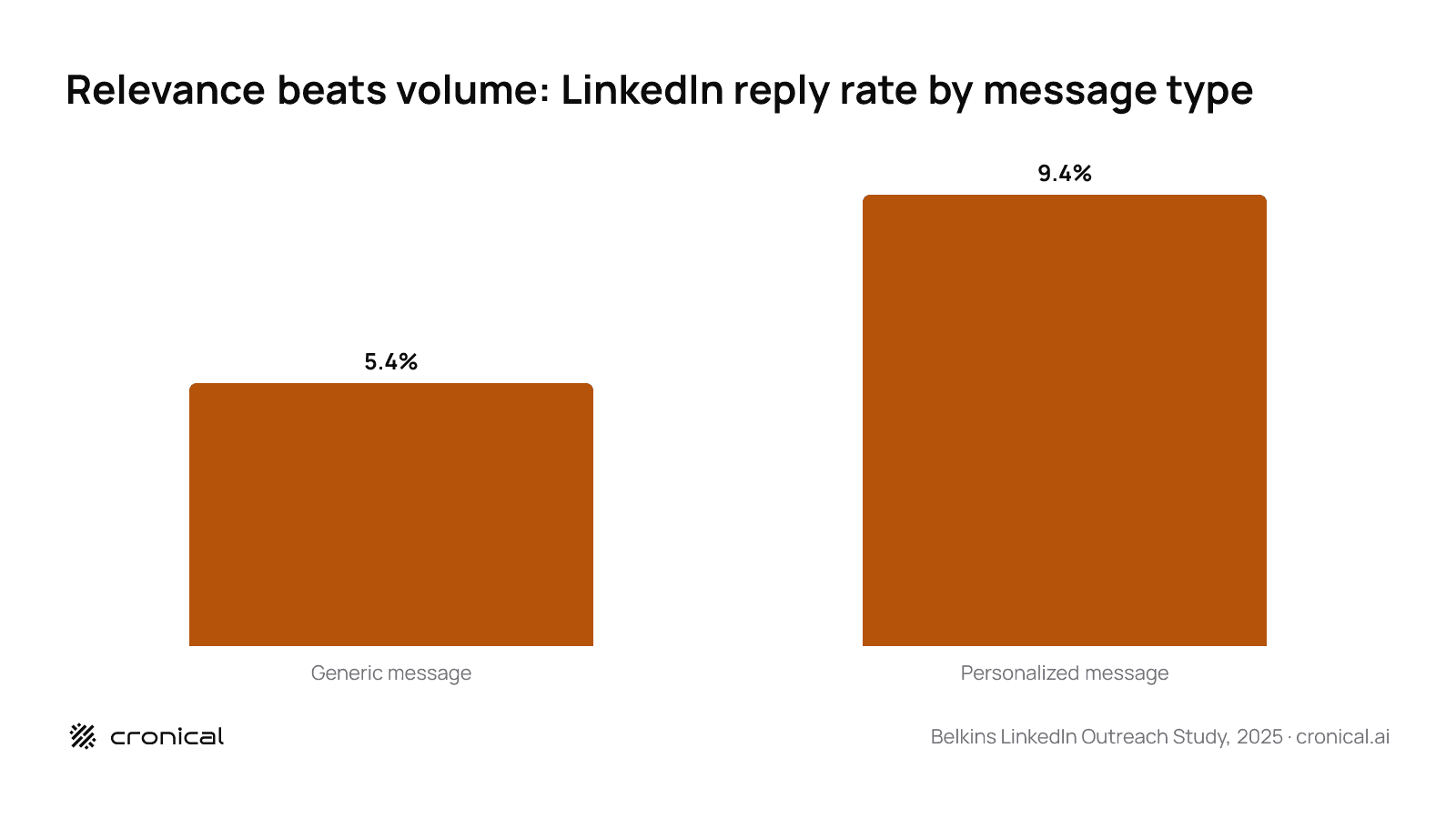
The clean comparison is relevance versus volume. A single well-aimed detail nearly doubles response: on LinkedIn, a personalized message replies at 9.36% versus 5.44% for a generic one. That lift comes from one relevant thing said well, not from a hundred fields appended to a record. The tenth data point does not find you a better sentence. The first good one already did.
I saw the same shape in financial markets. Every conference on alternative data lands on the same uncomfortable finding: the more datasets a fund piles on, the less the alpha moves. The datasets do not create an edge, because every fund has bought the same ones. It becomes a commodity data war where the net gain across the field is roughly zero. You cannot fall behind by not having the data, so you buy it, and so does everyone, and nobody pulls ahead. Outbound data is heading the same way. Owning the same enrichment vendor as your competitor is table stakes, not an advantage.
There is also a decay problem that hoarding ignores. B2B contact data goes stale at about 22.5% a year, so a giant database is partly rotting the day you buy it. Reply rates are drifting down on their own, too: Belkins clocked the average outbound reply rate falling from 6.8% in 2023 to 5.8% in 2024. More data does not reverse that. Better aim does.
The one rule that replaces the 20-layer GTM template
If you take one thing from this, take the rule, because it replaces the entire diagram. Add a layer only when the one beneath it is genuinely saturated.
Saturated means maxed out, not merely uncomfortable. Layer 1 is saturated when you are having as many manual conversations as you can personally handle and you know exactly who to look for. Only then does the ICP filter earn its place. The filter is saturated when you are hand-writing the same message to the same profile so often that your hands are the bottleneck. Only then does the sequencer earn its place. Each layer has to prove the one below it hit its ceiling before it gets added. That is the whole go to market strategy template, in one sentence, and it beats any grid because it tells you when to stop.
Tomasz Tunguz, who backs early companies at Theory Ventures, describes the same discipline from the investor's seat.
Most successful companies start with one motion & layer in the other as they scale.
Start with one. Layer in the next only when the first is full. The rule cuts both ways, which is the part worth sitting with: it tells you when to add, and it tells you when not to. If Layer 1 still has room, no tool and no dataset is going to help you, and buying one just moves work from the selling column to the admin column.
What earning each layer looks like in practice
In practice this looks unglamorous, and that is the point. For a stretch at the start you sit down, write your own messages, and call people yourself. No layers, no data. A founder already has a decent read on who needs the product, so use it. That founder-led stretch is not a phase to rush past. Bessemer, after studying how companies actually reach their first million in revenue, is blunt about who should be selling early.
There's no better salesperson at any company than the founder to talk about why they founded the company.
From that base you add layers slowly, checking that each one actually holds before you build on it. None of this means tools are useless. They are not. Top-performing sales teams do run roughly three times more sales technology than underperformers. The difference is direction of causation: those teams built a working motion and then amplified it with tooling. They did not buy the tooling hoping a motion would appear. The stack followed the sale, not the other way around.
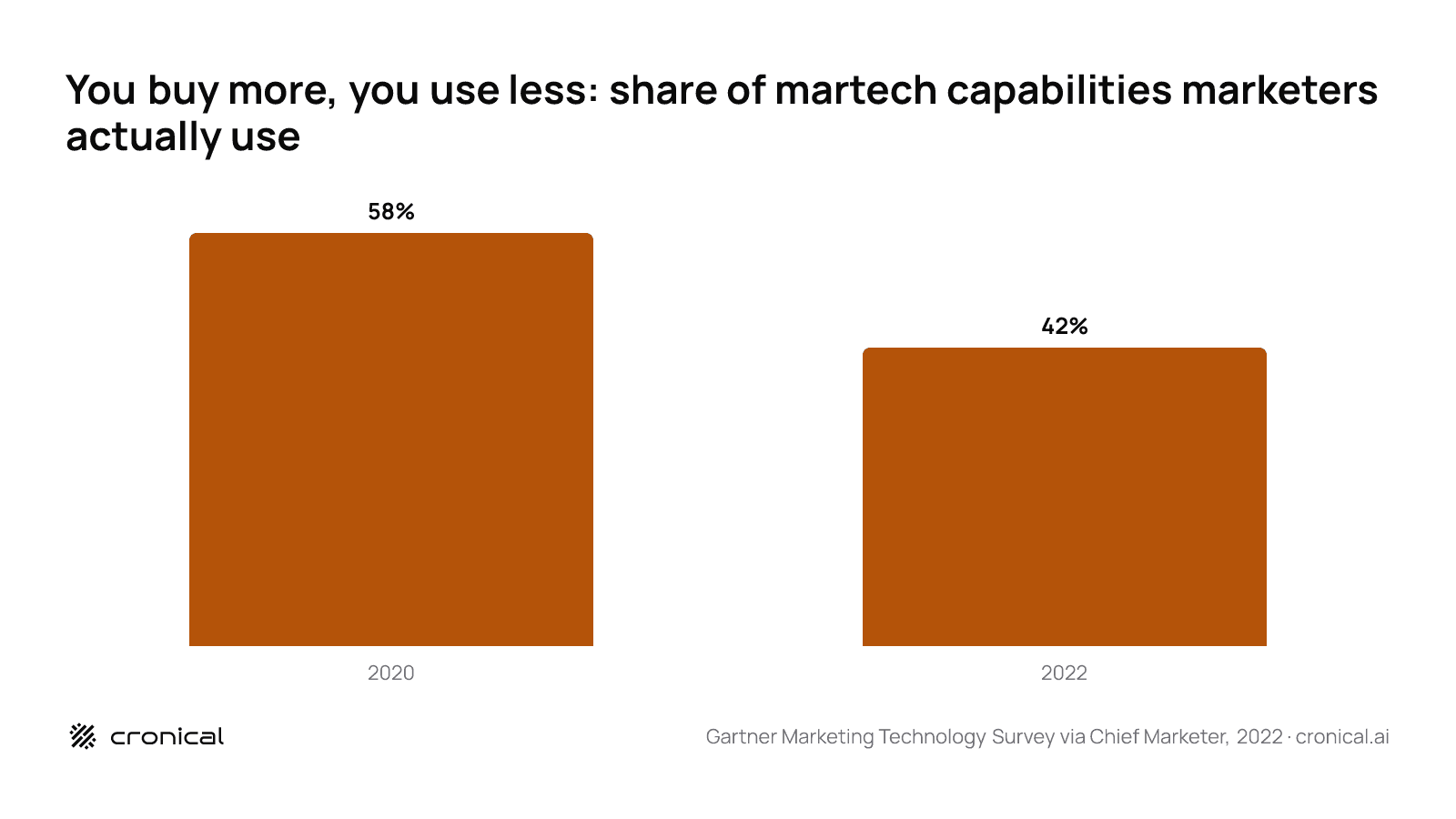
The cost of getting the order wrong shows up in the usage data. When teams buy capability ahead of need, the capability sits unused. Gartner found the share of martech capabilities marketers actually use fell from 58% in 2020 to 42% in 2022. More was bought, less was used. Every layer you add before its trigger is a candidate to become part of that unused half.
Your minimum viable GTM checklist
Run Minimum Viable GTM this week
- Pick one channel, phone, email, or LinkedIn, and commit to it for the next month instead of spreading across all three.
- Write and send your own messages by hand. Do not open a sequencer or buy a data tool yet.
- After 20 to 30 real conversations, write down the profile that actually answers and buys. That is your ICP filter.
- Only automate a message once you have sent it by hand enough times to know it gets replies.
- When you add data, cap it: one industry angle, one technographic, one signal. Nothing more until it proves out.
- Before adding any layer, check the layer beneath it is genuinely saturated. If it has room, do not add.
The bigger picture
Complexity is sold to you. Simplicity you have to earn, and earning it is slower and less impressive to post about, which is why the feeds are full of the other thing. A twenty-tier diagram photographs well. A founder making thirty calls a week does not. But the calls are what build a business, and the diagram is what builds someone else's consulting pipeline. When the next "layers of GTM" carousel makes you feel two steps behind, remember what it is engineered to do, and go send a message you wrote yourself.
How Cronical collapses the data layers
Cronical is the execution layer for teams running Minimum Viable GTM past the manual stage. Once you have a message that works and know who it is for, Cronical runs coordinated outbound across email and LinkedIn to the right people at your target accounts, and it folds the optional data layers, industry, technographic, and signal, into the send so you never have to assemble the castle yourself. It optimizes for account coverage, the share of your target companies you actually reach, rather than the open rate on one inbox. It is built for the founder or small team that has the motion but not the hours to replicate it by hand. Join the waitlist.
Methodology
FAQ
How many layers does a GTM strategy need to start?
Three. A brain and a channel, an ICP filter, and a way to replicate yourself. That is the minimum that produces real conversations. Every additional layer in the usual twenty-tier diagram is optional and should be added later, one at a time, only after the layer beneath it is fully saturated.
What is the minimum viable go-to-market strategy for a founder?
You, one channel, and messages you write by hand. Pick phone, email, or LinkedIn, and reach buyers directly without any tools or purchased data. A founder already knows the product and can read a conversation, which is everything Layer 1 requires. Add an ICP filter and automation only once the manual motion is working and maxed out.
Is the GTM tech stack overkill when you are starting?
For most first-time founders, yes. The number of martech tools available passed 15,000, and companies already leave about half of what they buy unused. Before you have a proven message, extra tools add admin, not pipeline. Buy tooling to amplify a motion that already works, not to create one.
What GTM tools do I actually need to start?
None. Layer 1 needs a phone or an email account and your own writing. Add a sequencer or an AI agent only when you are sending the same proven message repeatedly by hand. Add data tools only when a complex deal genuinely requires an industry, technographic, or signal to target and message correctly.
When should I add more data or a new layer?
Only when the layer beneath it is saturated, meaning maxed out rather than just uncomfortable. Layer 1 is saturated when you are handling all the manual conversations you can and know exactly who to target. The filter is saturated when hand-writing repeat messages is your bottleneck. That saturation rule replaces the entire stack diagram.