Key takeaways
- Data enrichment in B2B means adding external context to your records. The version that matters is not more fields on a contact, it is the signals and people that tell you which company to work and who to reach.
- A fully populated record with no reason to reach out and no map of the buying group is still a dead lead. Completeness is not the same as action context.
- B2B data decay is accelerating, so any account where you know one person is one job change away from going dark.
- The four layers (firmographic, technographic, intent, contact) work best as a sequence: pick the company, time the move, map the committee, cover the account.
- Measure share of the target account you have reached, not contact reply rate. Enrich to reach one inbox per company and you optimized the wrong number.
In This Post
- What data enrichment actually is (and what it is not)
- What shallow data really costs you
- The types of B2B data enrichment, and what each layer lets you do
- How data enrichment gets into your stack: CRM, API, and waterfall
- The Account Enrichment Stack: a framework for turning data into account coverage
- A worked data enrichment example, from blank list to multi-threaded account
- The real benefit of data enrichment: reach the whole account, not one inbox
- How to choose enrichment data without scaling bad outreach
- A data enrichment checklist
- How Cronical uses data enrichment
- Frequently asked questions
- Related reading
What data enrichment actually is (and what it is not)
Data enrichment is the practice of adding external information to your existing records so you know more about a company or a person than they handed you. You start with a domain, an email, or a half-filled CRM row, and you append the rest: industry, headcount, revenue, tech stack, job titles, contact details, buying signals. Every vendor on the first page of results opens with some version of that definition, and it is correct as far as it goes.
One scope note before anything else, because the word gets used in two unrelated fields. This guide is about B2B go-to-market enrichment, the data that sales and marketing teams use to find and reach buyers. It is not about machine-learning feature enrichment for data science, and it is not about candidate enrichment in recruiting. Same word, different jobs.
Here is where most guides stop and where the useful part starts. There are two very different things hiding under one term. The first is completeness enrichment: filling blank cells so a record looks full. The second is action-context enrichment: the signals and the people that tell you who to reach and why now. The industry sells the first and quietly implies it gets you the second. It does not.
A record can have a verified mobile number, a clean job title, a confirmed company size, and a tidy industry tag, and still be worthless, because none of that answers the only two questions outbound runs on: why should I reach this company today, and who else inside it do I need. Completeness makes a record look done. Action context makes it workable. They are not the same purchase.
That gap matters more than it sounds, because data does not sit still. In Validity's 2022 survey of CRM admins, 79% said data decay had accelerated to an unprecedented rate as people change jobs, companies merge, and titles shift. So the field you were proud of filling last quarter is already rotting. If your enrichment strategy is "make the record complete," you are bailing a boat. If it is "know enough about the account to keep reaching it when one person moves," you are building something durable.
More fields is not enrichment: completeness vs action context
Picture two records for the same target company. The first has forty fields filled, every cell populated, a green checkmark in your CRM's data-health view. The second has fifteen fields, but it tells you the company just posted three roles for the team you sell to, switched to a competing tool you replace, and has five named people across the function you would need to win. The first record looks better in a dashboard. The second is the one you can act on this morning.
That is the whole argument. Real enrichment is the in-market signal plus the map of who decides, not the count of how many boxes you ticked. For a concrete walk-through, the worked example below runs a flat list of domains all the way to a multi-threaded account. Hold that distinction as you read the rest, because every section returns to it.
What shallow data really costs you
The cost of bad data is usually waved at with one un-linked statistic and a shrug. It deserves real numbers, because the bill is large and most of it is invisible. Start with the people closest to the records. In Validity's 2022 survey of CRM admins, 44% estimated their company loses more than 10% of annual revenue to poor quality data. The number is large because the damage is diffuse: every team downstream of a bad record pays a little.
How bad is the baseline? Worse than most teams assume. In the same study, more than half of CRM admins rated their own data accuracy and completeness at less than 80%, and 75% said poor data quality had already cost their company customers. The damage is not theoretical. It shows up as bounced sends, misrouted deals, and outreach aimed at the wrong person.
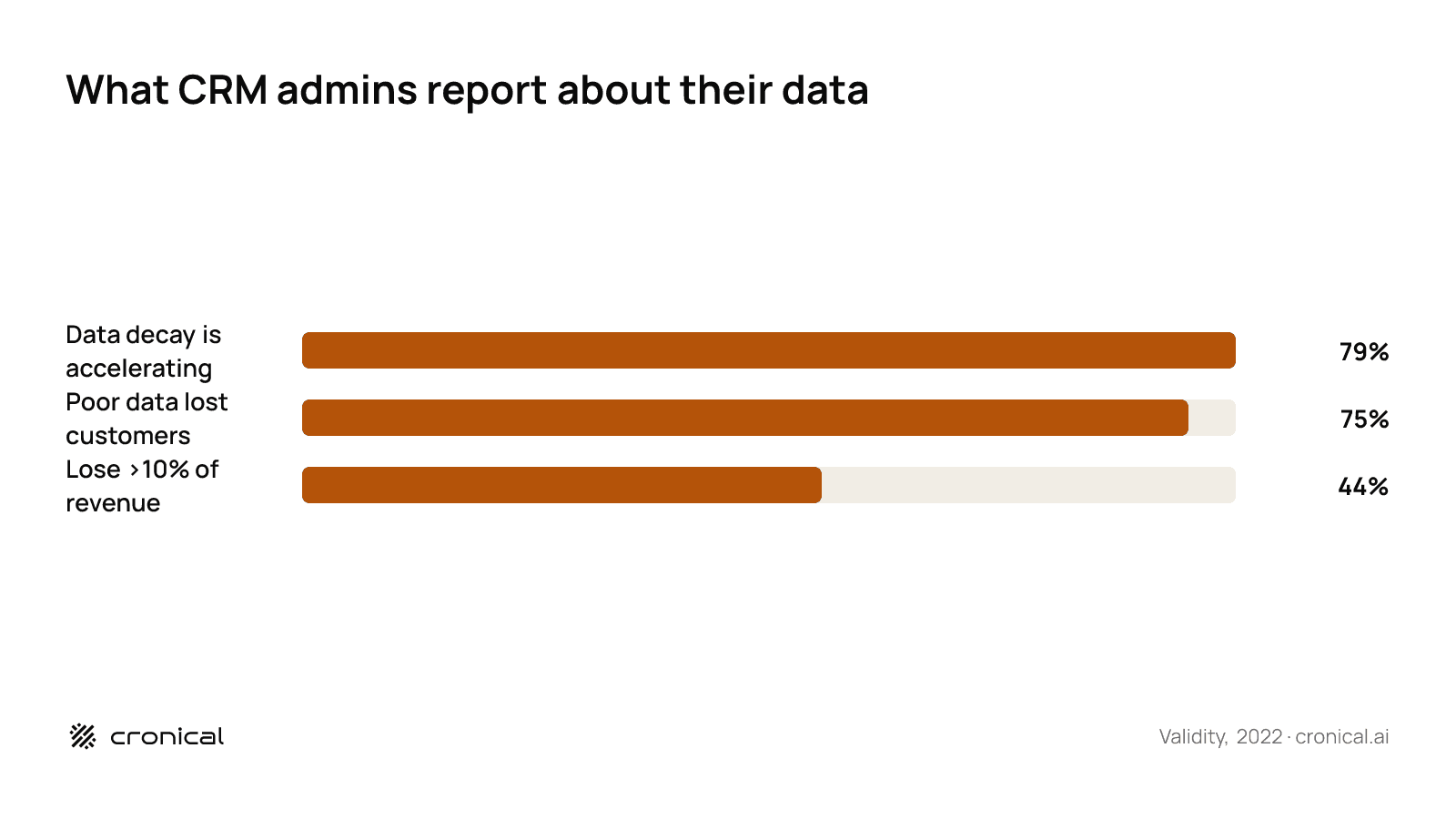
Read the chart and the picture is consistent. Decay is speeding up, the cost lands in lost customers and lost revenue, and the people who own the data expect it to get worse. That is the raw material most outbound runs on. Buy a list, enrich it for completeness, and you are still pouring effort into records that were broken before you touched them.
The data-quality authority Thomas Redman, known in the field as "the Data Doc," states the baseline plainly.
Bad data, really bad data, is the norm.
Why decay is an account-coverage problem, not a hygiene problem
Most teams read the decay number as a hygiene chore: clean the CRM so emails stop bouncing. That framing misses the real exposure. If a quarter to a third of your contacts go stale every year, then any account where you know exactly one person is one job change away from going completely dark. The deliverability problem is annoying. The single-thread problem kills deals.
I have watched a six-figure deal go quiet for exactly this reason. The record was perfect: verified contact, every field filled, a champion who replied fast. Then the champion left for a new company, and we had nobody else in the account. The deal did not die because the data was incomplete. It died because the data was deep on one person and absent on everyone else. Decay turned a complete record into a dead one overnight.
The durable hedge is depth, not cleanliness. More known, reachable people per account means one departure is a setback, not an extinction event. That reframes what enrichment is for: it is not how you keep records tidy, it is how you keep a line into the account when individuals churn.
The types of B2B data enrichment, and what each layer lets you do
Every guide lists the same four types of data enrichment and stops at the taxonomy. The layers are real and worth knowing, but the point is not to memorize four definitions. The point is what each one lets you do next, and how they stack into a way of working a whole company rather than scoring a single lead.
| Layer | What it appends | The question it answers | The next action it enables |
|---|---|---|---|
| Firmographic | Industry, size, revenue, location, structure | Is this company worth working at all? | Qualify in or out before you spend a minute enriching people |
| Technographic | Tools and platforms the company runs | Do they use what we replace or complement? | Prioritize accounts where you have a concrete reason to reach out |
| Intent | In-market topics, surges, hiring, funding | Why now, and is this account workable today? | Time the outreach to a live trigger instead of a cold guess |
| Contact | People, titles, roles, relationships, details | Who decides, and how do they relate? | Map the buying group so you can reach the committee, not one inbox |
Read down the last column and the sequence appears. Firmographic decides whether the company is even a fit. Technographic and intent decide whether now is the moment. Contact data decides who you actually reach. Stacked in that order, the four layers take you from a domain to a multi-threaded account. Piled up as fields on one person, they just make a fuller profile of someone who may not even be the right person.
Firmographic and technographic: which company, and why now
Firmographic data is the filter you run first. Before you enrich a single human being, you score the account on the things that decide whether you could ever sell to it: industry, employee count, revenue band, location, corporate structure. Enriching contacts at companies you would never close is the most common way enrichment budget gets burned. Qualify the company, then spend on the people.
Technographic data is the first half of "why now." If you replace or plug into a specific tool, knowing a company runs it turns a cold account into one with a concrete reason to talk. It is the difference between "we help companies like yours" and "we noticed you run X, and here is what that usually costs teams your size." One is a template. The other is a reason.
Intent and contact data: the signal and the committee
Intent data is the second half of "why now." It captures movement: a company researching your category, a surge in relevant searches, fresh funding, a hiring spree on the team you serve. Intent is what stops enrichment from being a static snapshot and makes it a clock. It tells you who fits and, more usefully, who is workable this week.
Contact and relationship data is where the account-coverage payoff lives. It maps the people: the roles on the buying group, who reports to whom, who has influence the org chart does not show. This is the layer that lets you stop treating a company as one inbox and start treating it as the group of people it actually is. In Gartner's 2025 sales research, B2B buying groups range from five to 16 people across as many as four functions. Enrich one of them and you are guessing at the rest. We go deeper on working that group in our guide to the B2B buying committee.
How data enrichment gets into your stack: CRM, API, and waterfall
Once you know what to enrich, there is the plumbing question: how does the data actually land in your systems. There are three mechanisms worth understanding, and they are simpler than the vendor pages make them sound.
CRM enrichment syncs appended data straight into the records you already keep, so a contact or account object fills out without anyone retyping. A data enrichment API is the programmatic version: your app or workflow sends an identifier (a domain, an email, a company name) and gets structured data back, which you can call on demand. And waterfall enrichment chains several providers in priority order, so when the first source has no match the request falls through to the next, which lifts overall coverage and match rate beyond what any single provider hits alone.
There is a timing axis too. Real-time enrichment fires the moment a record is created, for example filling in a company the instant someone submits a form, so a rep sees full context before the lead cools. Batch enrichment runs on a schedule against records you already hold, backfilling and refreshing in bulk. Most teams need both: real-time for inbound, batch to fight the decay rate on everything else.
Here is the trap in all of it. The plumbing is easy to celebrate and easy to misuse. Piping more fields into a CRM that nobody acts on at the account level does not give you pipeline. It gives you a tidier graveyard. The mechanism is only worth paying for if what comes out the other end changes who you reach and when. Redman makes the downstream cost explicit.
Too many errors leak through, rearing their ugly heads later on and leading to larger mistakes, bad decisions, and angry customers.
That is the cost of treating enrichment as a pipe rather than a decision. Errors do not announce themselves at ingestion. They surface three steps later as a rep emailing someone who left, a campaign segmented on a stale field, a deal worked through one contact who turned out not to decide anything.
The Account Enrichment Stack: a framework for turning data into account coverage
The four layers are useful, but a list of types is not a method. Here is the method I use, and it is deliberately a sequence, not a menu. Call it the Account Enrichment Stack. The core claim: enrichment is only worth paying for if it ends in account coverage, so you run the data layers as an ordered stack from company to committee to coverage, not as a pile of fields on one contact.
The framework
The Account Enrichment Stack
- 01
Qualify the company
Use firmographic fit first. Before you enrich a single person, score the account on industry, size, revenue, and fit. Enriching contacts at companies you would never sell to is the most common waste in the whole motion. No fit, no spend.
- 02
Time the move
Layer technographic and intent signals. The tech stack, the hiring, the in-market topics tell you which qualified accounts are workable now. This is how you point enrichment budget at companies that can actually move this quarter instead of someday.
- 03
Map the committee
Now enrich the people. Find the stakeholders who will decide, their roles, and how they relate. The goal is a map of the buying group, so you know who to reach across the account, not just the one inbox that answered a form.
- 04
Cover the account
Reach the committee in parallel, with a specific reason for each person, and track share of the account reached rather than contact reply rate. Coverage is the output the first three steps exist to produce.
The order is not decoration. You cannot map a committee before you have decided the company is worth working, and you cannot measure coverage before you have mapped who is in the account. That dependency chain, company then timing then committee then coverage, is what makes it a stack rather than a checklist. Skip a step and the later ones have nothing to stand on. Enriching people at an unqualified account is wasted spend; measuring coverage without a committee map is measuring against a number you invented.
This is a vendor-agnostic way to work, not a product. Any team with decent enrichment sources and a CRM can run it. What it changes is the unit of work: you stop enriching contacts and start enriching accounts.
A worked data enrichment example, from blank list to multi-threaded account
Definitions are easy to nod along to and hard to apply, so here is one end-to-end example. Start with the least enriched thing there is: a flat list of company domains, nothing else. No names, no titles, no signals. Just a column of URLs from a conference attendee export.
Step one, firmographic. Append industry, headcount, and revenue, then cut the list hard. Half the domains are too small, in the wrong vertical, or otherwise outside what you sell to. They are gone before you spend another cent. What remains is a shorter list of companies that could actually buy.
Step two, technographic and intent. Layer in the tech stack and live signals. A handful of the survivors run the exact tool you displace, and three of those also posted roles last month for the team you sell into. That subset moves to the top. You now have a small set of accounts with a fit and a reason, instead of a big list with neither.
Step three, contact data. For each of those priority accounts, enrich the people: the five to eight stakeholders across the relevant function, their titles, and how they connect. One domain that started as a bare URL is now a mapped buying group with named roles. This is what the example is really showing. The cell that got filled was never the point; the account that came into focus was.
Step four, coverage. You reach that committee in parallel, each person with a reason that fits their seat: the economic buyer hears the cost case, the technical evaluator hears the integration story, the end user hears the day-to-day. One blank domain became a multi-threaded account. That is a worked data enrichment example, and notice that no step was about making a single record look complete. Every step moved you toward covering a company.
The real benefit of data enrichment: reach the whole account, not one inbox
The standard benefits list reads the same everywhere: better segmentation, sharper personalization, improved deliverability, smarter lead scoring. All true, all framed at the level of a contact or a campaign. The benefit that actually moves pipeline sits one level up, and it is the one the listicles skip.
The real benefit of data enrichment is account coverage: reaching and holding more of each target company, so one job change does not end the deal. Tie it back to decay. When 79% of CRM admins say their data is decaying faster than ever, depth across the account is the only thing that survives churn. Enrichment that ends at one complete contact is a coverage risk dressed up as an asset. Enrichment that maps and reaches the committee is insurance.
The pressure for coverage is rising on its own, because buyers are spreading their attention across more places than ever.
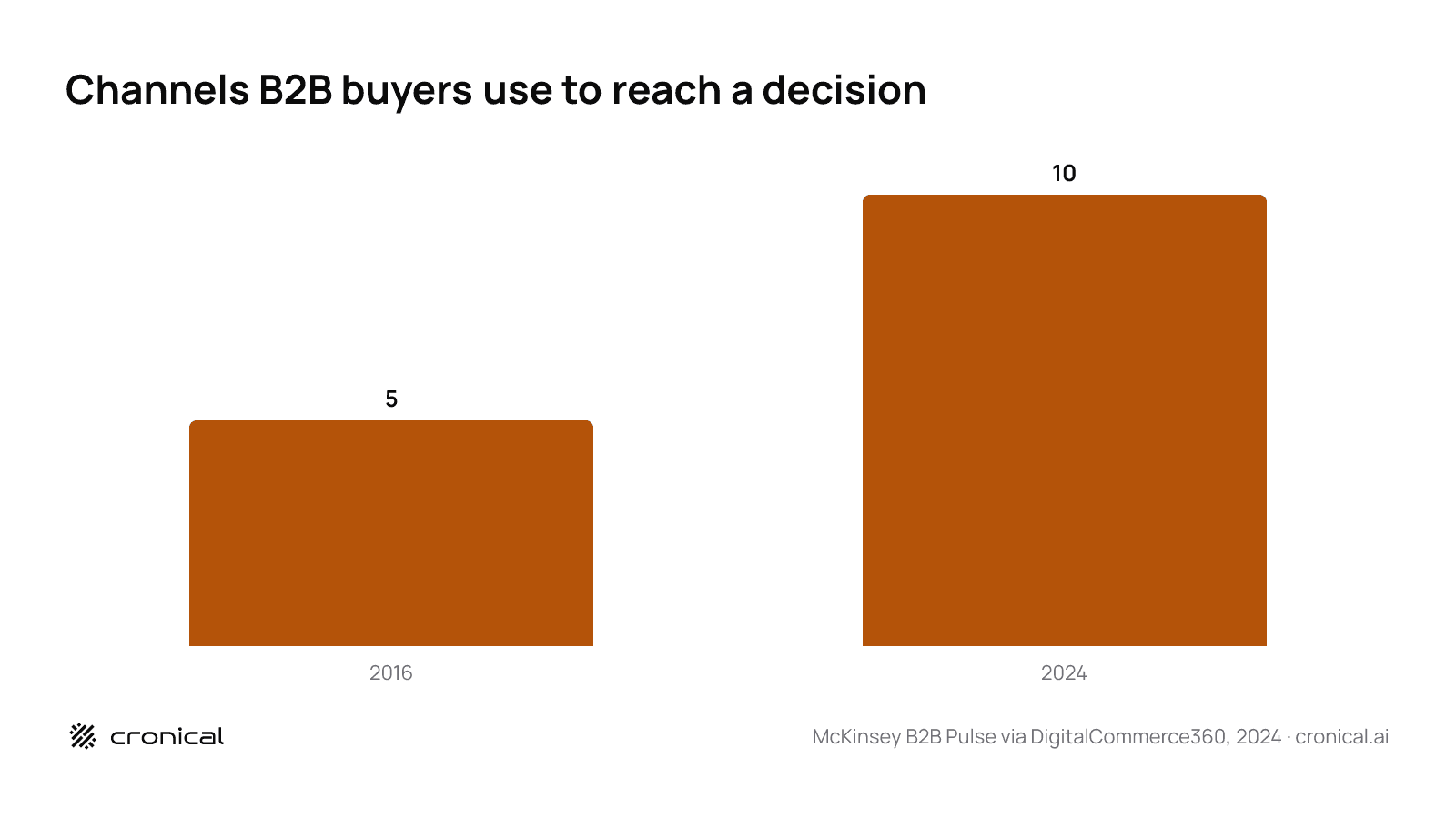
B2B buyers now use ten or more channels to reach a decision, up from five in 2016, according to McKinsey's B2B Pulse. A bigger committee using more channels is exactly why one enriched inbox per company stops working. You are not trying to win a person anymore. You are trying to win a group that is researching you from ten directions at once, which is the heart of account-based GTM.
So change the number you celebrate. If you enrich to reach one inbox per company, you optimized for reply rate and lost the account. Measure share of the buying committee you have actually touched. That single metric shift is what turns enrichment from a data expense into a pipeline input. Confidence in the underlying data is shaky to begin with, which makes the discipline harder and more valuable.
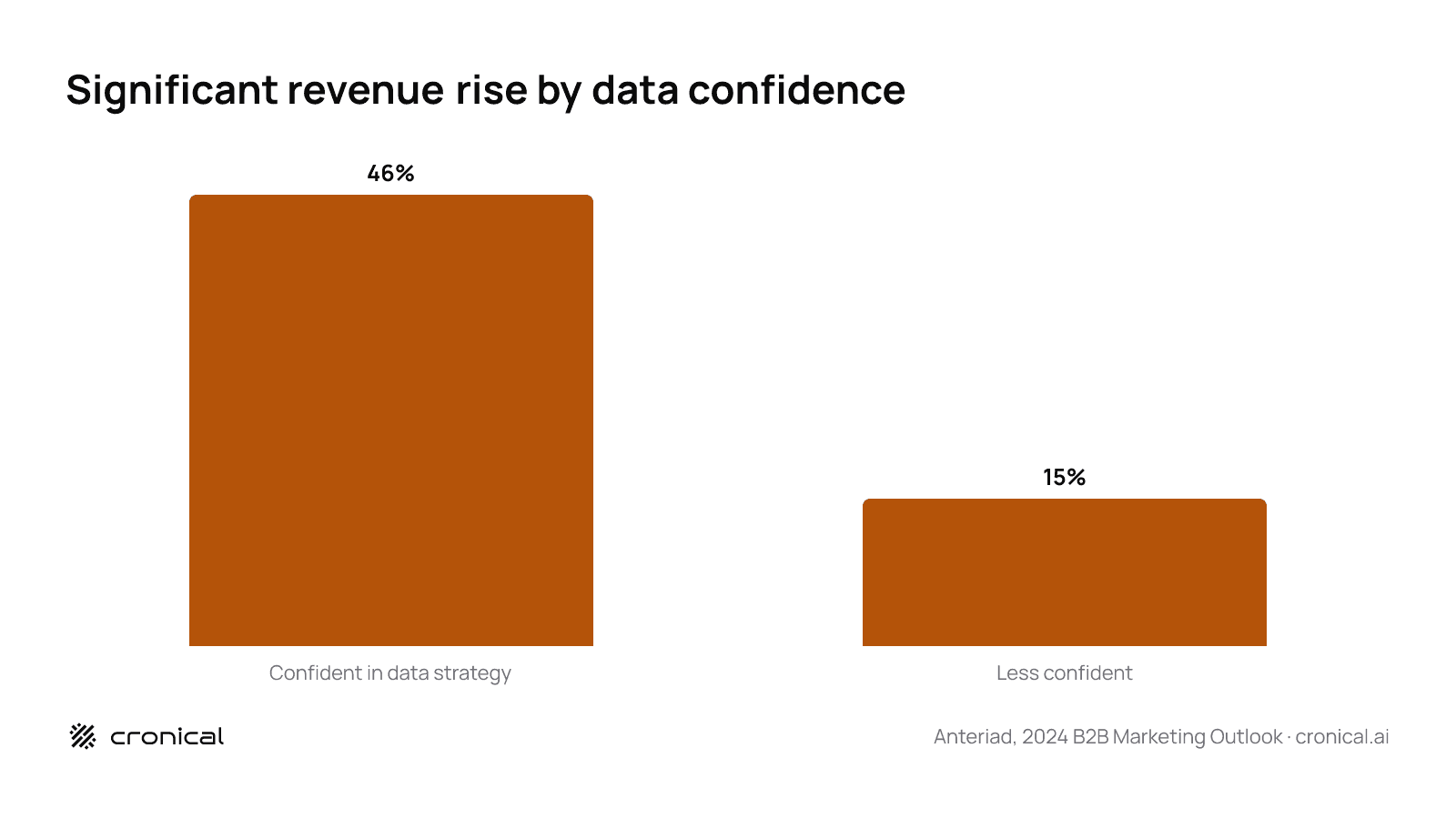
The gap is the story. 46% of B2B marketers confident in their data strategy reported a significant revenue increase last year, versus just 15% of their less confident peers, per Anteriad. Confidence in the data tracks straight to revenue, and most teams do not have it. Enrichment aimed at coverage is how you earn that confidence on the accounts that count.
How to choose enrichment data without scaling bad outreach
Buyer-intent searches for data enrichment tools and data enrichment companies land you in vendor listicles that compare field counts. Field count is the wrong axis. The classic warning applies straight to outbound: garbage in, garbage out. Enrich a bad list faster and you have not fixed anything, you have just sprayed and prayed with cleaner grammar. The data layer is worthless if the motion underneath is still one contact per company. We made the broader case for why that motion is failing in is cold outreach dead.
When you evaluate an enrichment source, bias hard toward coverage and committee depth over field count. Ask how many of the right companies it actually covers, not how many attributes it returns. A vendor that adds twelve vanity fields but cannot tell you who else is in the building loses to one that maps the committee. The non-selling tax on reps is already brutal: they spend only 28% of their week actually selling, per Salesforce, with the rest lost to admin and data entry. Enrichment that creates more cells to maintain makes that worse. Enrichment that tells you who to reach and why makes it better.
The right enrichment tells you which company to work and who is on the committee. The wrong enrichment makes spray-and-pray look organized. Choose for the first.
A data enrichment checklist
What this means for you
- Separate completeness from action context. Audit whether your enrichment fills cells or tells you who to reach and why now.
- Qualify the company before you enrich the people. Score accounts on firmographic fit first, and cut the misfits.
- Layer technographic and intent signals to decide which qualified accounts are workable this quarter.
- Map the buying group: aim for every stakeholder per account, not one inbox.
- Pick the metric that matters: track share of the account reached, not contact reply rate.
- Choose sources for coverage and committee depth over field count, and re-enrich on a schedule to fight accelerating data decay.
How Cronical uses data enrichment
Cronical is built for account-first cold outreach: it works the whole company, from the VP to the director to the ops lead to the champion, instead of blasting one contact and hoping. Enrichment in that model is fuel for a single number, account coverage, the share of each target company you actually reach. Rather than stopping at a complete record, Cronical uses the data layers to map the buying committee and multi-thread it in parallel, so one job change never takes a deal dark. If that is the way you want to run outbound, join the waitlist.
Frequently asked questions
What is data enrichment?
Data enrichment is the practice of adding external information to your existing records so you know more about a company or person than they gave you. In B2B go-to-market, that means appending firmographic, technographic, intent, and contact data. The version that drives pipeline is not filling more fields, it is gathering the signals and the people that tell you which account to work and who to reach.
What are some data enrichment examples?
Examples include appending a company's industry, headcount, and revenue from a bare domain (firmographic), detecting which software a company runs (technographic), flagging that a company is researching your category or hiring on a relevant team (intent), and mapping the named stakeholders on the buying group with their titles and relationships (contact). The strongest example runs end to end: a flat list of domains enriched into a qualified, multi-threaded account.
What is a data enrichment API?
A data enrichment API is the programmatic way to get enriched data on demand. Your application or workflow sends an identifier such as a domain, email, or company name, and the API returns structured data in response. It contrasts with CRM sync (data pushed into your records) and waterfall enrichment (several providers chained so a miss on one falls through to the next, raising overall match rate).
What is the difference between firmographic and technographic data?
Firmographic data describes the company itself: industry, size, revenue, location, and structure. It answers whether a company is worth selling to at all. Technographic data describes the tools and platforms a company uses. It answers whether you have a concrete reason to reach out, for example because the company runs software you replace or complement. Firmographic qualifies the account; technographic helps time the move.
What are the benefits of data enrichment?
The commonly cited benefits are better segmentation, personalization, deliverability, and lead scoring. The benefit that actually moves pipeline is account coverage: reaching and holding more of each target company so a single job change does not kill the deal. With most CRM teams reporting that data decay is accelerating, depth across the account is the only durable hedge against churn.