Key takeaways
- Account-based GTM is a company-wide operating model: sales, marketing, and CS work from one account list, one set of playbooks, and one definition of winning.
- It is broader than ABM. ABM is a marketing targeting tactic; account-based GTM runs the full lifecycle from first touch to expansion.
- The average B2B buying group is 11 people and ranges up to 16 across four functions, so any account-based plan lives or dies on reaching a group, not a person.
- The metric that proves it works is account penetration rate: the share of target accounts where you reached a real conversation, not just a delivered email.
- The execution gap is the distance between picking accounts and penetrating them. Closing it is a coverage problem, and it is now solvable without a full RevOps stack.
In This Post
- What is account-based GTM?
- Account-based GTM vs. traditional ABM
- The core components of account-based GTM
- The benefits, and the metric that proves them
- The execution gap: strategy without account penetration
- How to close the execution gap
- How Cronical turns account-based GTM into account penetration
- FAQ
What is account-based GTM?
Account-based GTM is a go-to-market model that organizes the whole company around a defined list of high-value accounts, rather than around a volume of individual leads. Sales, marketing, and customer success share the same target list, the same account intelligence, and the same scoreboard. The unit of work is the account, not the contact, and the unit of success is whether you win and keep the account, not how many forms got filled.
That sounds obvious until you look at how most teams still run. Marketing chases MQLs, sales chases its own contacts, and CS finds out about the account only after the deal closes. Account-based GTM collapses those three motions into one, pointed at companies you have actually decided are worth winning.
The short version
Lead-based GTM asks "how many people can we capture this month?" Account-based GTM asks "which companies do we want, and is the whole company moving them forward together?" The second question is harder to answer and far more valuable when you can.
The reason this model exists is that B2B buying changed underneath the old one. Buyers do most of their work before they ever talk to you. Gartner found that B2B buyers spend only 17% of their total purchase journey meeting with potential suppliers, and when they are comparing several vendors at once, any single rep gets just 5% to 6% of that time. You cannot win a deal in 5% of the buyer's attention by treating it as a stream of disconnected leads. You win it by covering the account.
Account-based GTM vs. traditional ABM
ABM and account-based GTM get used as synonyms all the time. They are not the same thing, and conflating them is why a lot of programs underdeliver.
ABM, account-based marketing, is a targeting methodology. It is marketing concentrating spend and attention on a named set of accounts instead of spraying demand-gen across the whole market. It is real, it works, and it is mostly top-of-funnel. Account-based GTM is the operating model that ABM lives inside. It takes the same account-first logic and extends it across every function and every stage, from first touch through renewal and expansion.
| Account-based marketing (ABM) | Account-based GTM | |
|---|---|---|
| Scope | A marketing tactic | A company-wide operating model |
| Who runs it | Marketing | Sales, marketing, and CS together |
| Lifecycle stage | Mostly top-of-funnel demand | First touch through renewal and expansion |
| Unit of measure | Account engagement and pipeline | Won and retained accounts |
| Owns the account list | Marketing's target list | One shared list across all three teams |
ABM is a tactic inside the larger account-based GTM operating model. Running ABM without the rest is doing half the job.
The practical test: if your "account-based" effort is a marketing campaign that hands a list to sales and then disengages, you are doing ABM. If the same account list drives how sales sequences outreach, how marketing runs air cover, and how CS plans the expansion conversation, you have account-based GTM. The first is a campaign. The second is how the business runs.
The core components of account-based GTM
Four pieces have to be in place. Skip any one and the model degrades back into lead-based motion with account-based language bolted on top.
What has to be in place
The four components of account-based GTM
- 01
A real ICP and account list
Not a vague persona. A scored, named list of companies worth concentrated effort, built from firmographics, technographics, and fit. This is the foundation everything else points at.
- 02
Cross-functional alignment
Sales, marketing, and CS working from the same list and the same definition of a won account. Without it you get three teams running three motions at the same logos and stepping on each other.
- 03
Intent and account intelligence
Signals that tell you which accounts are in-market now and who inside them is researching. This is what turns a static list into a prioritized queue worth acting on this week.
- 04
Shared, account-level metrics
One scoreboard measured at the account level, not the lead level. If marketing reports MQLs and sales reports contacts, you do not actually have a shared model yet.
Most published frameworks stop here. They describe these four components, declare the teams aligned, and move on. The problem is that all four are inputs. None of them is the act of reaching the account. You can have a flawless ICP, perfect alignment, the best intent data money can buy, and a clean account-level dashboard, and still not have a single real conversation inside a target account. That gap is the rest of this post.
The benefits, and the metric that actually proves them
The case for account-based GTM holds up in the data. Account-based programs concentrate effort where the money is, which shows up as bigger deals and better alignment. Forrester and AdRoll found that 58% of B2B marketers experienced larger deal sizes with ABM, and account-based teams instrument their work more seriously: 6sense reports that ABM teams track 5.2 metrics on average versus 3.4 for non-ABM teams. The approach is also mainstream now, not experimental. 64% of marketers say their team runs an account-based or target-account approach.
Most guides dodge the next part. "More revenue" is not a metric you can manage. Revenue is the lagging outcome of a dozen things, and it tells you nothing about whether your account-based motion is actually working week to week. You need a leading metric that maps directly to the model. That metric is account penetration rate.
Account penetration rate is the share of your target accounts where you have reached a real conversation, not just a delivered email or a connection request. Pick a definition of "real" and hold to it: a reply that goes somewhere, a meeting, a live thread with someone who matters. Then measure what fraction of your named accounts cleared that bar. If you targeted 200 accounts and have a genuine conversation going in 40, your penetration rate is 20%. That number moves before pipeline does, it is fully in your control, and it is the cleanest proof that account-based GTM is happening rather than just being planned.
Why penetration and not contact-level reply rate? Because the decision is made by a group. The average B2B buying group is 11 people and ranges from five to 16 across as many as four functions. Reaching one of them well does almost nothing if the other ten never hear from you. The win-rate data is blunt about this.
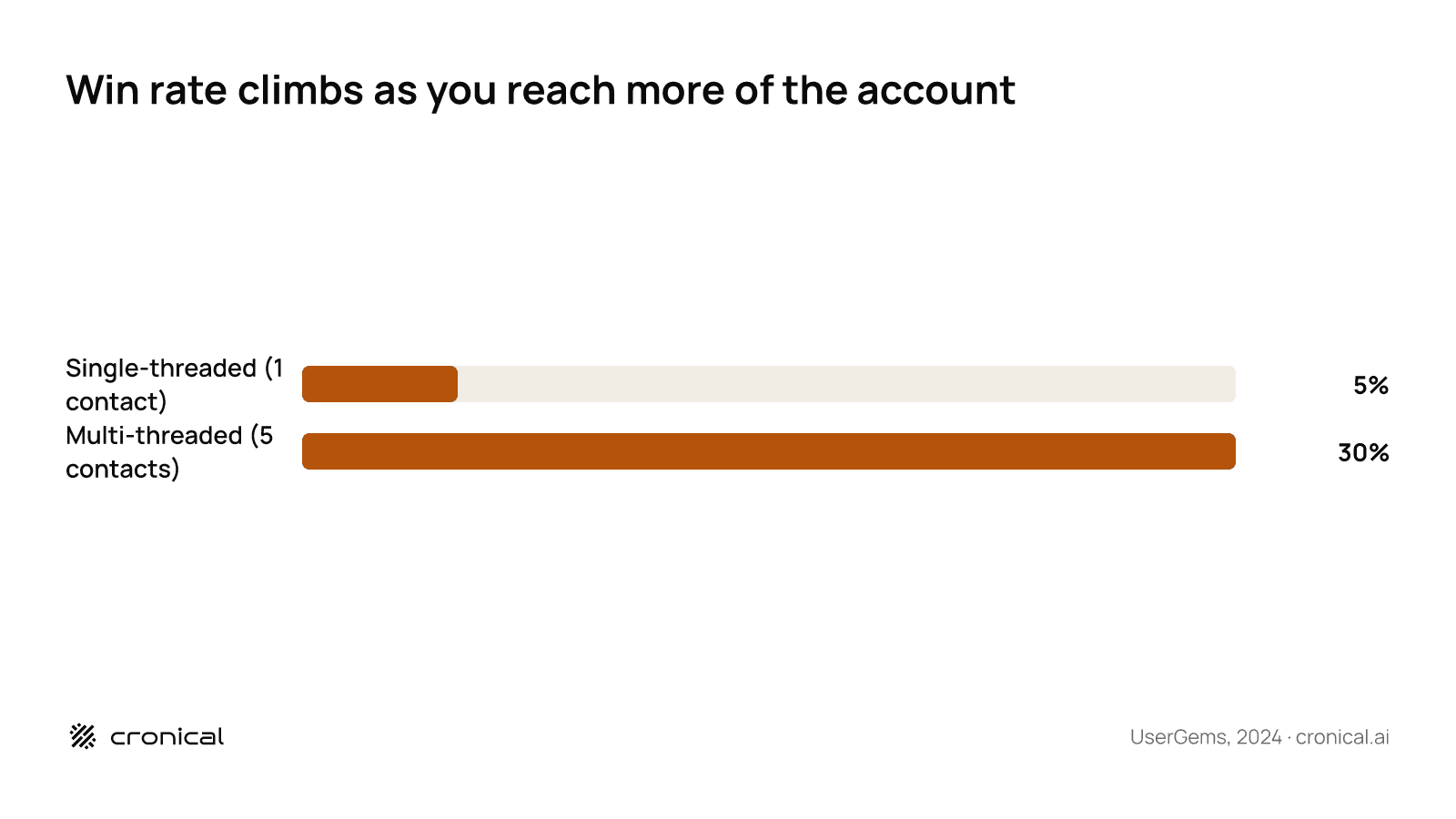
A single-threaded opportunity wins around 5% of the time. Reach five contacts and that climbs to roughly 30%, a six-fold improvement in UserGems' analysis of 500 closed deals. Account penetration rate is the metric that tells you whether you are on the right side of that gap. If you want the full picture of who those five-plus people are and how the group decides, we cover it in the guide to B2B buying committees.
The execution gap: strategy without account penetration
Every account-based GTM framework you can find online stops at the inputs. Align the teams, pick the accounts, layer on intent data, build the dashboard. All correct, all necessary, and all useless if the conversations never happen. The distance between a finished account list and a penetrated account is the execution gap, and it is where most account-based GTM strategies quietly die.
Why aligning the teams isn't enough
Alignment solves coordination. It does not solve coverage. You can have sales, marketing, and CS perfectly synced on the same 200 accounts and still be reaching two contacts per account, both of them the same easy-to-find titles, while the people who actually carry risk in the decision never hear from anyone.
The buying group is the reason this matters so much. Reaching the account is not reaching a person; it is reaching enough of a group, in the right roles, that internal consensus can form. And consensus is exactly where deals fail. Gartner found that 74% of B2B buyer teams show unhealthy conflict during the decision process, and a large body of research shows where that conflict leads.
Matthew Dixon and Ted McKenna put a number on the cost after studying millions of sales conversations.
Anywhere between 40% and 60% of deals today end up lost to customers who express their intent to purchase, but ultimately fail to act.
Those are not deals lost to a competitor. They are deals lost to indecision inside the account, the kind that only gets resolved when enough of the group is engaged and aligned. A single-threaded relationship cannot do that work. You are not in the rooms where the doubt lives.
Penetrating the buying committee, not just targeting the account
Targeting an account means putting it on a list. Penetrating it means getting genuine conversations going with the cluster of people who decide. Those are different verbs and most teams only do the first one.
The difficulty is structural, and it compounds. The group is large and split across functions. Buyers do most of their evaluation before they talk to you, so by the time you reach one person, opinions are forming without you. 6sense found that 81% of buyers have a preferred vendor before they ever speak to sales, and that the majority of the journey is finished in the dark.
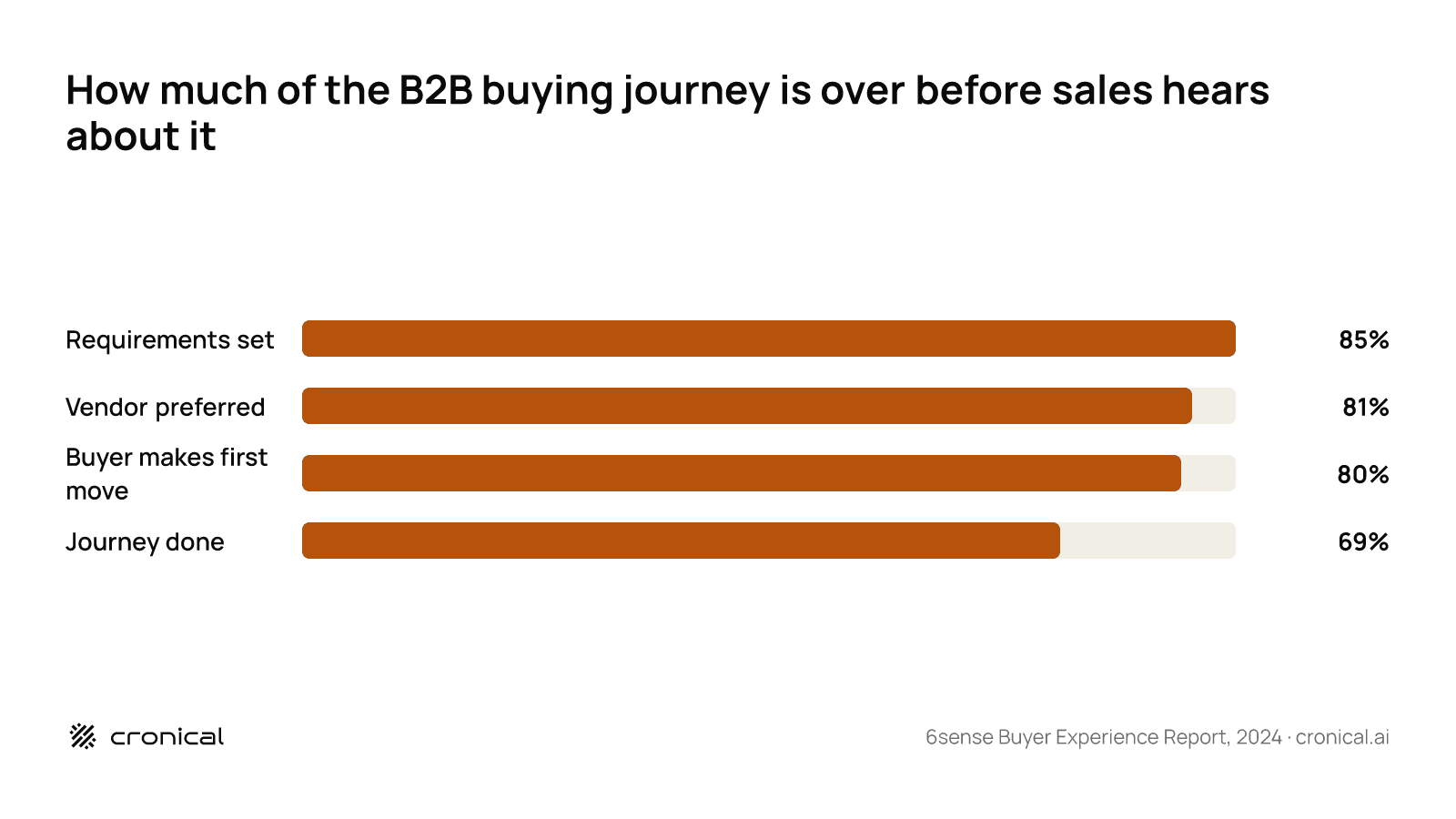
Read that chart as a clock. 69% of the buying journey is done before a seller is engaged and 85% of buyers have set their requirements before contacting sales. If you are reaching one contact late, you are arriving after the requirements that decide the deal have already been written, by people you never spoke to. Penetration early and across the group is the only way to be in the room while those requirements are still forming.
This is hard partly because nobody has much time to do it manually. Salesforce found that reps spend less than 30% of their week actually selling; the rest goes to admin and internal meetings. Asking a rep to research and personalize outreach to 11 stakeholders across 200 accounts, by hand, is asking for the thing that never gets done. So it does not get done, and the execution gap stays open.
How to close the execution gap
Closing it is a coverage problem with a definite shape. The fix is to treat penetration as the job, not a byproduct of alignment, and to run it as a repeatable loop.
Closing the execution gap
The Penetration Loop
- 01
Map the group, not the contact
For each target account, list the roles that decide: economic buyer, the users, the technical or security gatekeeper, the likely champion. You are defining the coverage target before you send anything, so you know what 'penetrated' means for this account.
- 02
Reach the roles in parallel, with role-fit messages
Engage the whole group close together, each with a message built for what that role cares about, across both email and LinkedIn. Parallel beats serial: waiting for one thread to reply before starting the next is how you arrive after the requirements are set.
- 03
Measure penetration, not sends
Track account penetration rate, the share of accounts with a real conversation underway, and engagement depth within each account, how many of the mapped roles are actually responding. Sends and opens are vanity. Conversations are the leading indicator.
- 04
Close the coverage gaps
Every week, find the accounts that are under-penetrated or missing a critical role, and route the next effort there. The loop is the discipline of repeatedly comparing where you are reaching against the map and chasing the gaps until the account is covered.
The reason it is a loop and not a checklist is that accounts do not stay covered. People change jobs, new stakeholders join the evaluation, a champion goes quiet. Penetration is a state you maintain, not a box you tick, which is why step four feeds back into the map.
Two things make the Penetration Loop runnable rather than aspirational. The first is multichannel reach, because the group does not all live in one inbox; McKinsey found that B2B buyers now use ten or more channels to interact with suppliers, double the five they used in 2016. The second is automation that can carry the per-stakeholder personalization a human cannot do at this scale. This is where AI earns its place in account-based GTM, and it is not hypothetical: Salesforce reports that 81% of sales teams are now experimenting with or have fully implemented AI. The useful application is not writing generic copy faster. It is running role-specific, account-wide outreach so the loop actually closes.
That reframes who can run account-based GTM. The old assumption was that you needed a full RevOps stack and a team to operate it. You do not. A founder selling their own product, or a two-person team, can run the Penetration Loop against a focused list if the reach and personalization are handled for them. The model was never really about headcount. It was about coverage, and coverage is now buyable as software.
Run the Penetration Loop on your accounts
- Define what counts as a real conversation, and make account penetration rate a tracked number, not a vibe.
- For your top accounts, write down the roles that decide before you write a single message.
- Reach those roles in parallel, not one at a time, with a message built for each role's risk.
- Use both email and LinkedIn, since the group does not all answer the same channel.
- Each week, list your under-penetrated accounts and the missing roles, then route effort straight at the gaps.
- Pull one recent lost deal and count how many of its committee you ever actually reached. The number is usually the lesson.
How Cronical turns account-based GTM into account penetration
Account-based GTM is the strategy. Account penetration is whether it happened. Cronical is the execution layer that closes the gap between the two: it runs coordinated email and LinkedIn outreach across the whole buying committee inside each target account, with role-specific messaging and timing so your threads reinforce each other instead of colliding, and it optimizes for account penetration rate, the share of target companies you actually reached, rather than the reply rate of one contact. It is built for the team that has the account list and the strategy but not the hours or the RevOps stack to penetrate every account by hand. Join the waitlist.
FAQ
What is account-based GTM?
Account-based GTM is a go-to-market operating model where sales, marketing, and customer success all work from one list of high-value target accounts, using shared account intelligence and a shared, account-level scoreboard. The unit of work is the company, not the individual lead, and success is measured by which accounts you win and keep.
What is the difference between account-based GTM and ABM?
ABM, account-based marketing, is a marketing targeting tactic focused mostly on the top of the funnel. Account-based GTM is the broader operating model that ABM lives inside: it applies the same account-first logic across sales, marketing, and CS, and across the full lifecycle from first touch to renewal and expansion. ABM is part of account-based GTM, not a synonym for it.
How do you build an account-based GTM strategy?
Put four components in place: a scored ICP and named account list, cross-functional alignment so sales, marketing, and CS share that list and one definition of a won account, intent and account intelligence to prioritize who is in-market now, and account-level metrics. Then close the execution gap by actually penetrating the buying committee inside each account, measured by account penetration rate.
What are the components of account-based GTM?
A real ICP and target account list, cross-functional alignment across sales, marketing, and CS, intent and account intelligence, and shared account-level metrics. Those four are the inputs. The missing fifth piece in most frameworks is execution: reaching the buying group inside each account, not just listing the account.
Why use account-based GTM?
Because B2B decisions are made by groups of around 11 people who do most of their evaluation before they talk to you, and concentrating effort on the right accounts produces larger deals and tighter alignment. Account-based programs report bigger deal sizes, and multi-threaded deals win at several times the rate of single-threaded ones. The catch is that the benefits only show up if you actually penetrate the accounts, not just target them.