Key takeaways
- Account-based outreach is the execution layer of ABM: the actual act of reaching a target account, not the strategy that picks it. ABM chooses the accounts, account-based selling is how the team operates, account-based outreach is whether you reached the committee.
- An account is a group, not a person. The average B2B buying group is around 11 stakeholders, so reaching one contact leaves the account mostly uncovered by definition.
- Single-threaded deals win about 5% of the time. Reach five people and that climbs to roughly 30%, a six-fold jump, so single-threading is a structural 5% bet.
- The number that proves the motion is account coverage rate: the share of target accounts where a real conversation is underway across the committee. It moves before pipeline does and it is fully in your control.
- You do not need a six-figure RevOps stack to run account-based outreach. You need a committee map, a parallel email-and-LinkedIn sequence, and a coverage number you check every week.
In This Post
- What account-based outreach actually is (and what it isn't)
- Why single-threaded outreach fails
- Account coverage is the metric that proves the motion
- The Account Coverage Sequence
- How to do account-based outreach, step by step
- Multichannel outreach: email and LinkedIn in parallel
- Account-based outreach without an enterprise stack
- How Cronical runs account-based outreach
- FAQ
- Related reading
What account-based outreach actually is (and what it isn't)
Account-based outreach is the act of reaching a target account: getting real conversations going with the people inside a company you have decided is worth winning. That is it. It is not a strategy document and it is not a dashboard. It is what happens after the planning stops and someone actually has to land in the inboxes and feeds of the people who will decide.
The reason the term is confusing is that three different things share the same vocabulary, and most of the content ranking for this keyword treats them as one. They are not one. Pulling them apart is the whole game.
ABM, account-based marketing, is the targeting strategy. It decides which named accounts are worth concentrated effort instead of spraying demand across the whole market. Account-based selling is the operating model: how the team is organized, compensated, and coordinated to work those accounts as accounts rather than as a pile of leads. Account-based outreach is the execution layer underneath both. It is whether you actually reached the committee inside the account this week. You can have a flawless ABM list and a textbook account-based selling motion and still have reached one person at a 200-account target list. The strategy can be perfect and the outreach can still not have happened.
That number is the reason the distinction matters. The average B2B buying group is now around 11 stakeholders, spread across functions that each carry a different kind of risk. When the group is that large, "reach the account" stops being a figure of speech. It is a coverage problem with a count attached. Reaching one well-chosen contact is not reaching the account. It is reaching about a tenth of it.
Account-based outreach vs ABM vs account-based selling
Here is the clean three-way split, stated plainly, because no one else on this topic states it cleanly.
| ABM | Account-based selling | Account-based outreach | |
|---|---|---|---|
| What it is | A targeting strategy | An operating model | The execution, the act of reaching |
| The question it answers | Which accounts? | How does the team run? | Did we reach the committee? |
| Who owns it | Marketing and RevOps | Sales leadership | Whoever sends the messages |
| Unit of work | The account list | The account team and process | The conversation inside the account |
| How you know it's working | Pipeline from target accounts | Team adoption and rigor | Account coverage rate |
ABM picks the accounts, account-based selling is how the team operates, account-based outreach is whether you actually reached them. Vendors use the three interchangeably. They are not interchangeable.
If you remember one thing from the split, make it this: ABM and account-based selling describe intent. Account-based outreach is the only one of the three that produces a conversation. The rest of this post is about the last column.
Why single-threaded outreach fails
Single-threading is reaching one person in an account and running the deal through them. It feels efficient. You found a champion, they like you, the thread is warm, why bother the rest of the org. The problem is that the math on this approach is bad, and it is bad in a way that is easy to ignore right up until the deal dies.
I have lost a deal exactly this way. There was a champion who loved the product, took every call, forwarded the deck internally, told me we were the front-runner. The deal died anyway. When I pulled the post-mortem, I counted how many people in that account I had ever actually spoken to. The answer was one. The security reviewer who killed it on a data-residency concern, the finance lead who reset the budget, the VP who quietly preferred the incumbent, none of them had ever heard from me. Consensus formed in three rooms I was not in. The deal did not die to a competitor. It died because I had reached a tenth of the account and called it covered.
The win-rate data is blunt about how common that outcome is.
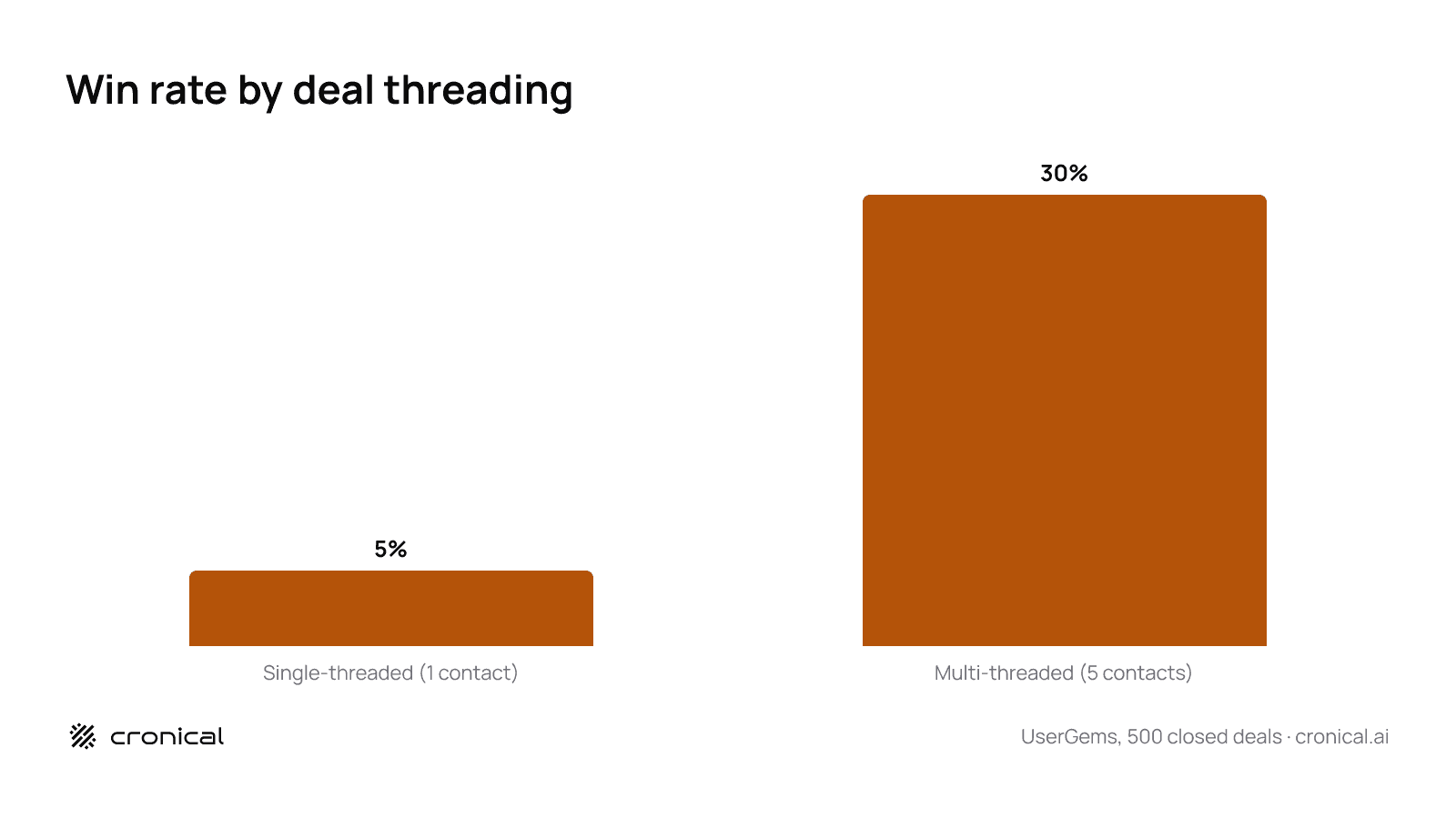
A single-threaded opportunity wins about 5% of the time. Reach five people and that climbs to roughly 30%, a six-fold improvement in UserGems' analysis of 500 closed deals. Read that as a structural fact, not a tactic. If you single-thread, you are not running a 50-50 deal that you happen to be losing. You are running a 5% bet and calling it a pipeline. The way you change the odds is not a better email to the one contact. It is reaching more of the group.
And the group is where deals actually die. Matthew Dixon and Ted McKenna studied this at scale and named the real killer.
Anywhere between 40% and 60% of deals today end up lost to customers who express their intent to purchase, but ultimately fail to act.
Those are not losses to a rival vendor. They are losses to indecision inside the account, the no-decision outcome that only resolves when enough of the group is engaged and aligned. A single-threaded relationship cannot do that work, because the indecision lives with people the single thread never reaches.
The committee is the unit, not the contact
Every problem above traces back to one mistake: treating the contact as the company. The contact is not the company. The contact is one vote, often not even the deciding one, inside a group that has to reach internal agreement before money moves. When you build outreach around a person, you optimize for a relationship. When you build it around the committee, you optimize for coverage of the group that actually decides. Those are different jobs, and only the second one is account-based outreach. The role breakdown of who sits on that committee, and what each one cares about, is worth its own read in our guide to B2B buying committees.
Account coverage is the metric that proves the motion
If account-based outreach is reaching the committee, then the number that proves it is working is the share of accounts where you have reached enough of the committee. That is account coverage rate, sometimes called penetration rate, and it is missing from almost every guide on this topic. Competitors measure activity (touches sent), or marketing engagement (account engagement score), or the lagging outcome (pipeline). None of those tells you, this week, whether the outreach motion is actually landing.
Account coverage rate is the share of your target accounts where a real conversation is underway across more than one role on the committee. Pick a definition of "real" and hold to it: a reply that goes somewhere, a meeting booked, a live thread with someone who matters. Then ask what fraction of your named accounts clear that bar, and how many roles inside each one are responding. If you targeted 200 accounts and have a genuine multi-role conversation going in 40 of them, your coverage rate is 20%.
Watch this number instead of send volume, and your week changes shape. I would judge a rep's week by how many accounts they genuinely covered, not by how busy the sequence looked. A thousand sends across one contact per account is a busy week and a 5% bet. Forty accounts with three roles engaged is a quieter dashboard and a far better forecast. Coverage maps straight onto the single-threaded-versus-multi-threaded win-rate math: it is the leading indicator of the side of that 5%-to-30% gap you are on.
The reason it has to be a leading metric, not a trailing one, is timing. Most of the decision is finished before a seller is ever in the room.
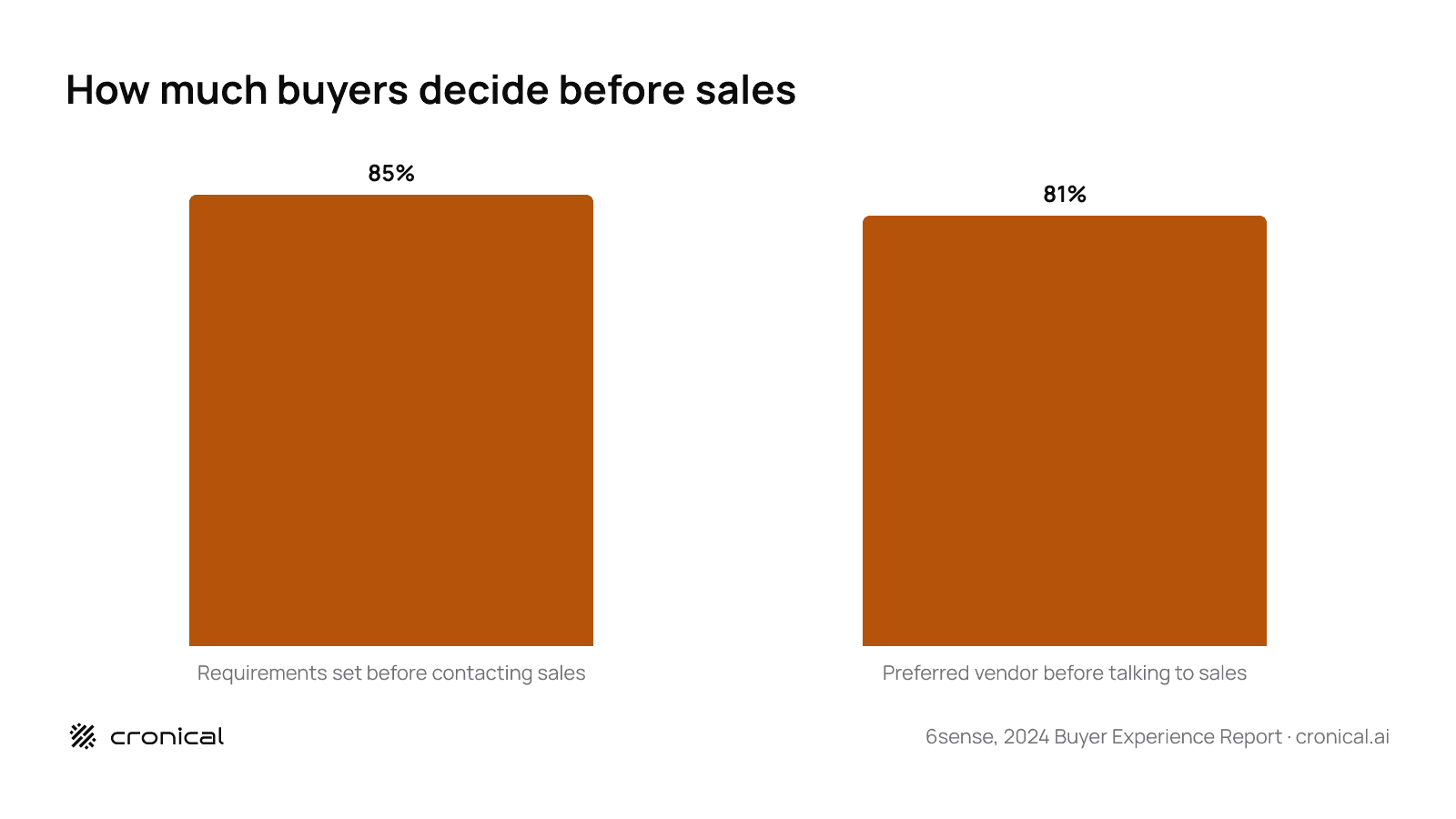
85% of buyers set their requirements before they contact sales, and 81% have a preferred vendor before they ever speak to a rep. Gartner's view is the same from the other side: buyers spend only 17% of the purchase journey meeting with potential suppliers, and split across competing vendors, any one rep gets a sliver of that. If you are covering the account late and narrow, the decision forms without you. Coverage early and across the group is the only way to be in the room while the requirements are still being written. We define this metric in the context of the broader strategy in our account-based GTM guide.
The Account Coverage Sequence
Coverage does not come from personalizing harder at one contact. It comes from running a repeatable sequence in a specific order, where each step depends on the one before it. Skip a step or run them out of order and coverage leaks. That is what makes this a framework and not a checklist: the order is load-bearing.
A repeatable motion for account-based outreach
The Account Coverage Sequence
- 01
Map the committee, not the contact
For each target account, list the deciding roles before you send anything: economic buyer, the users, the technical or security gatekeeper, the likely champion. This is what gives 'covered' a definition for this specific account. Without the map, you cannot tell whether you have reached enough of the group or just the easy contact.
- 02
Sequence the roles in parallel across channels
Engage the mapped roles close together, each with a message built for what that role carries risk on, on email and LinkedIn at once. Parallel beats serial because waiting on one thread to reply before starting the next is how you arrive after the requirements are set. The map from step one is what makes parallel possible: you already know who to hit.
- 03
Measure penetration
Track account coverage rate (share of accounts with a real conversation underway) and engagement depth (how many mapped roles are responding). Read progress at the account level, not per send. This step only works because step one defined the denominator: you cannot measure coverage of a committee you never mapped.
- 04
Route at the gaps
Every week, surface the under-penetrated accounts and the specific roles still missing, and aim next week's effort there. This feeds back into the map, because accounts do not stay covered: people change jobs, new stakeholders join, a champion goes quiet. Coverage is a state you maintain, not a box you tick.
The sequence is a loop, not a line. Step four feeds step one. An account you covered last month can be under-covered today because the committee changed underneath you. The discipline is repeatedly comparing where you are reaching against the map, and chasing the gaps until the account is genuinely covered.
How to do account-based outreach, step by step
The Account Coverage Sequence is the model. Here is how it runs as a weekly motion you can actually execute.
Map the committee before you send anything
Before a single message goes out, write down the roles that decide for this account. Not names yet, roles: who signs, who uses it daily, who reviews it for security or legal, who is most likely to champion it internally. Then fill the roles with real people from LinkedIn and your data. This is unglamorous and it is the step everyone skips, which is exactly why most "account-based" outreach is single-threaded outreach with a nicer label. The map is what turns "reach the account" into a finite, checkable list.
Sequence the roles in parallel, not serially
Start the roles close together rather than waiting for one to reply before touching the next. Serial outreach feels safer and it is slower in the only way that matters: it lets consensus form before you are in it. Each role gets a message built for their risk. The economic buyer hears about outcome and payback. The security gatekeeper hears about controls and data handling. The user hears about the daily job getting easier. Same account, same week, different message per role.
Measure penetration weekly and route effort at the gaps
At the end of each week, look at coverage, not activity. For every target account, how many mapped roles have a live conversation? Sort by the gap. The accounts with one role engaged and four roles dark are where next week's effort goes, aimed at the specific missing roles. This is the routing step, and it is what keeps the motion honest: you are always working the thinnest coverage, not the warmest contact.
Run account-based outreach on your accounts
- Define what counts as a real conversation, and make account coverage rate a tracked number rather than a vibe.
- For your top accounts, write down the deciding roles before you write a single message.
- Start the roles in parallel, not one at a time, with a message built for each role's risk.
- Use both email and LinkedIn, since the committee does not all answer the same channel.
- Each week, list your under-covered accounts and the missing roles, then route effort straight at the gaps.
- Pull one recent lost deal and count how many of its committee you ever reached. The number is usually the lesson.
Multichannel outreach: email and LinkedIn in parallel
The committee does not all live in one inbox, which is why multichannel outreach is not a nice-to-have for this motion. It is how you actually reach a group of different people with different habits. The reply-rate data on combining email and LinkedIn is strong when the targeting is tight.
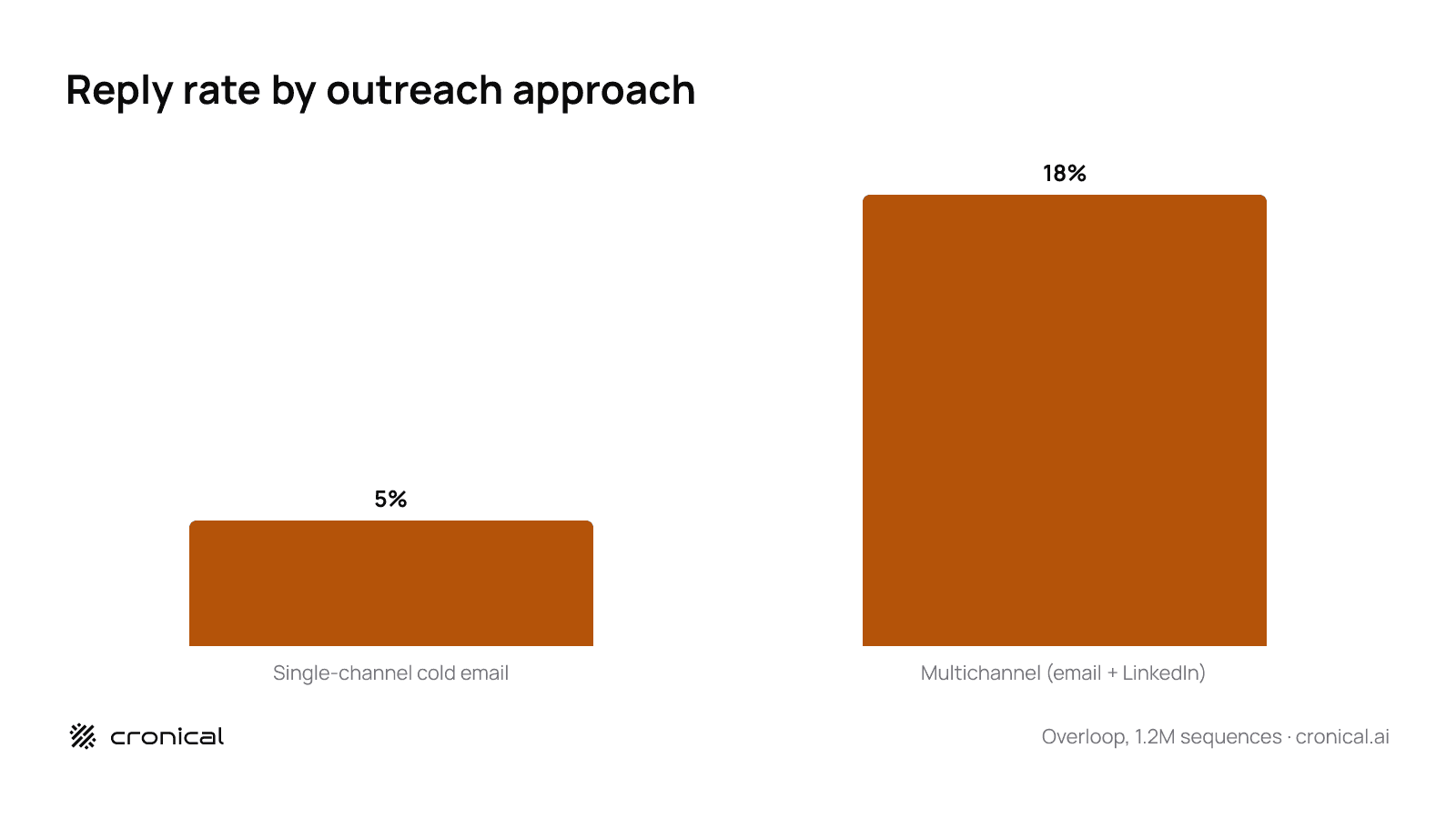
On tight ICP lists, single-channel cold email lands a reply from around 5% of top-performer sequences, while multichannel teams running email plus LinkedIn report 15% to 25%, three to four times the single-channel rate, in Overloop's analysis of 1.2 million sequences. The lift is real, but the mechanism matters more than the number. Two channels let you reach roles where they actually pay attention, and they let touches reinforce each other.
Done well, multichannel reads as presence, not pestering. A LinkedIn connection request warms the inbox so the cold email lands from a name the person half-recognizes. An email that references the post they just engaged with on LinkedIn reads as attention, not automation. Hitting the same person on two channels in the same week, with messages that acknowledge each other, looks like a seller who is genuinely working their account. Hitting them on two channels with the same generic line twice looks like a bot with a bigger budget. The difference is whether the channels are coordinated or just duplicated. When the targeting is loose, multichannel is just noise on two channels instead of one. This is the same shift away from volume outbound that we covered in is cold outreach dead: the channel count is not the point, the coordination is.
A 14-day email and LinkedIn sequence mapped to committee roles
A concrete version: over two weeks, you run the mapped roles in parallel, not a single track. Day 1, send the LinkedIn connection request to the champion and the user, and the first role-fit email to the economic buyer. Day 3, email the user about the daily-job angle while the champion's connection warms. Day 5, send the security gatekeeper a controls-and-compliance note on email, and engage the economic buyer's recent post on LinkedIn. Day 8, follow up the economic buyer referencing the requirement they likely care about. Day 11, send the champion a short LinkedIn message now that you are connected. Day 14, a coverage check: which roles replied, which are still dark, and where next cycle's effort goes. The point is not the exact calendar. It is that four roles are in motion together, so consensus cannot quietly form without you.
Account-based outreach without an enterprise stack
Account-based outreach got mis-sold as an enterprise-only motion: that it needs an intent platform, an ABM ad orchestration layer, and a RevOps team to operate the whole thing. That is the version vendors sell because it is the version that needs their platform. It is not what the motion actually requires.
What a lean team actually needs is three things: a committee map, a parallel email-and-LinkedIn sequence, and a coverage number it checks every week. None of those require a six-figure stack. A founder selling their own product, or a two-person sales team with a focused account list, can run the Account Coverage Sequence by hand on a small list. The constraint is not budget. It is hours.
And hours are exactly where it breaks. Salesforce found that reps spend less than 30% of their week actually selling; the rest goes to admin and internal meetings. Asking a rep to research and personalize outreach to four or five roles across a hundred accounts, by hand, every week, is asking for the thing that never gets done. So it does not get done, the outreach quietly collapses back to single-threading the one easy contact, and the 5% bet is back. The motion is simple. Running it consistently at any volume is what is hard, and that is a tooling problem, not a strategy problem.
How Cronical runs account-based outreach
Account-based outreach is reaching the committee, and the thing that makes it hard is doing that consistently across many accounts without a RevOps team. That is what Cronical is built for: it runs coordinated email and LinkedIn outreach across the whole buying committee inside each target account, with role-specific messaging and timing so your threads reinforce each other instead of colliding, and it optimizes for account coverage rate, the share of target companies you actually reached across the group, rather than the reply rate of one contact. It is the execution layer for the team that has the account list and the strategy but not the hours or the stack to cover every account by hand. Join the waitlist.
FAQ
What is account-based outreach?
Account-based outreach is the act of reaching a target account: getting real conversations going with the buying committee inside a company you have decided is worth winning. It is the execution layer of account-based marketing. ABM picks the accounts and account-based selling is how the team operates, but account-based outreach is whether you actually reached the group of people who decide, not just one contact.
Why is account-based outreach important?
Because B2B decisions are made by a group of around 11 people who finish most of their evaluation before they talk to you, and reaching one of them does almost nothing. Single-threaded deals win about 5% of the time versus roughly 30% for multi-threaded ones. Account-based outreach is how you cover enough of the committee to be in the room while the decision is still forming, instead of arriving after the requirements are set.
How do you do account-based outreach?
Map the deciding roles in each account before you send anything, sequence those roles in parallel across email and LinkedIn rather than one at a time, measure account coverage rate (the share of accounts with a real multi-role conversation underway), and each week route effort at the under-covered accounts and missing roles. The order matters: the committee map is what gives coverage a definition and makes parallel sequencing possible.
What is the difference between account-based outreach and ABM?
ABM, account-based marketing, is the targeting strategy that decides which accounts are worth concentrated effort. Account-based outreach is the execution underneath it: the act of actually reaching the committee inside those accounts. ABM answers "which accounts?" Account-based outreach answers "did we reach them?" You can run ABM perfectly and still have done no real outreach.
Is account-based outreach the same as account-based selling?
No. Account-based selling is the operating model: how the sales team is organized and coordinated to work accounts as accounts. Account-based outreach is the specific act of reaching the people inside those accounts. Account-based selling is how the team runs; account-based outreach is what produces the conversations. A team can have a strong account-based selling motion and still be single-threading every account in practice.