Key takeaways
- B2B appointment setting is the work of turning cold prospects into booked sales meetings, run by phone, email, and LinkedIn.
- Agencies charge $50 to $500 per appointment or $3,000 to $10,000 monthly retainers. A full-time in-house SDR runs $110,000 to $150,000 a year all-in.
- Pay-per-appointment pricing rewards booking, not showing. Average no-show rates sit at 20 to 35%, and cold-sourced meetings show up less than half the time.
- Judge any model on cost per held meeting, not cost per booked one. Most pricing pages quietly hope you never run that math.
- AI tooling now lets the team that actually knows the product run the same outreach motion in-house, which is where this market is heading.
In This Post
- What is B2B appointment setting?
- What does an appointment setter do?
- How B2B appointment setting works
- Appointment setting services and companies
- In-house vs outsourced agency vs AI
- Sales appointment setting that actually books meetings
- Lead generation and appointment setting, together
- The Meeting Yield Stack
- How Cronical does appointment setting
- Frequently asked questions
- Related reading
What is B2B appointment setting?
B2B appointment setting is the work of contacting prospects who have never heard of you and converting some of them into booked meetings for a closing rep. The channel does not define it. Calls, email, LinkedIn, even X: any channel that carries a message can carry an ask for a meeting. What defines it is the handoff. The setter's job ends when a qualified meeting lands on a salesperson's calendar.
Grace Lau, who runs growth content at Dialpad, gives the cleanest definition I have seen in print.
B2B appointment-setting is the process of scheduling an official meeting between a qualified lead and a closing sales rep.
The definition is simple. The market built on top of it is not. "Appointment setting" today means three different things depending on who is selling it to you: an in-house SDR function, an outsourced agency that books meetings for a fee, or software that runs the motion for your own team. I have spent ten years in this industry and hired appointment setting companies myself, so this guide covers all three, including the parts the agencies' pricing pages leave out.
What does an appointment setter do?
An appointment setter, usually titled SDR or BDR in-house, spends the day building lists, researching accounts, writing and sending outreach, making calls, handling objections, qualifying interest, and wrestling the calendar invite over the line. Then they log all of it in the CRM.
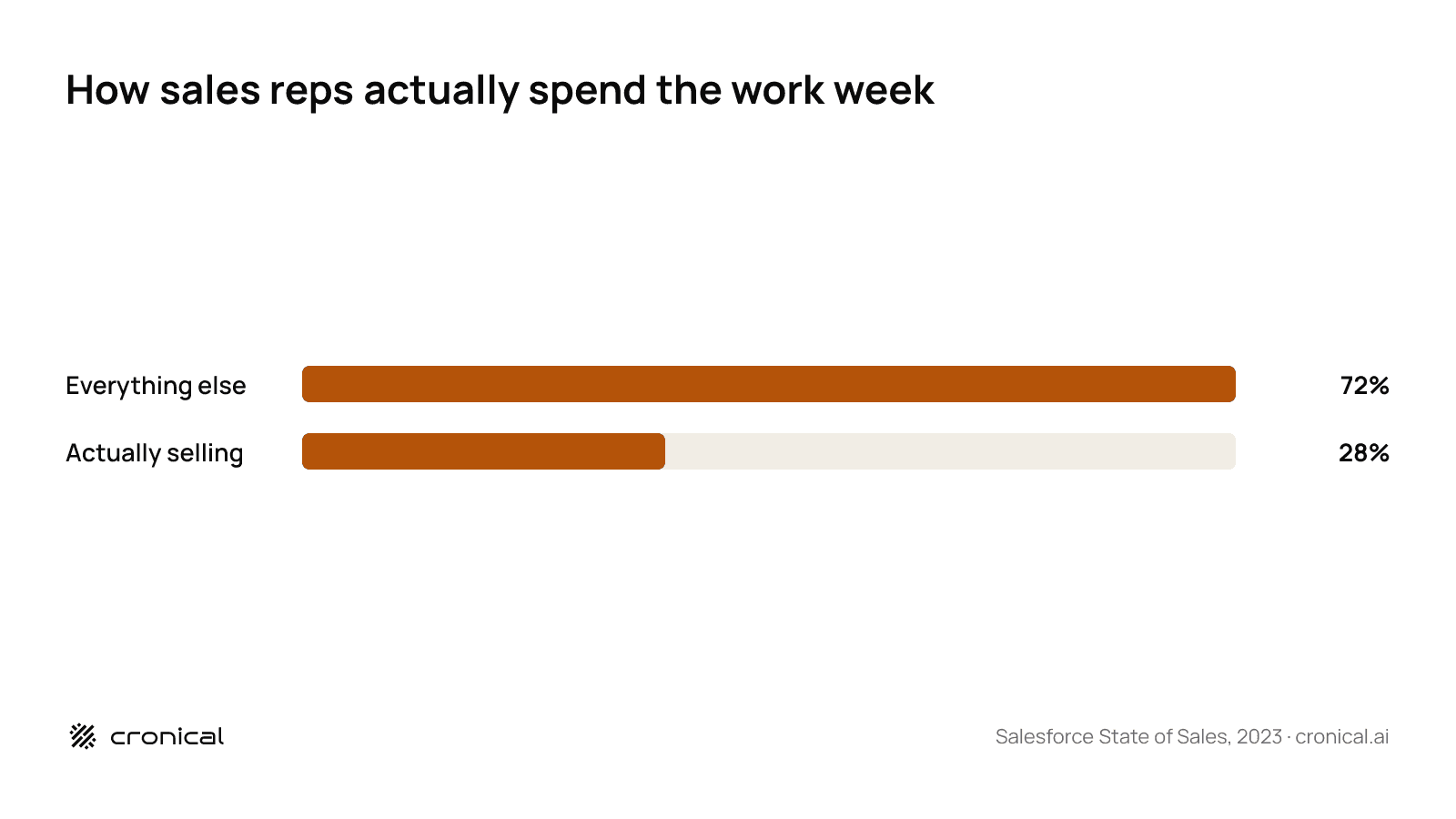
Notice what is missing from that list: selling. Salesforce surveyed thousands of sales professionals and found that reps spend just 28% of their week actually selling, with the rest consumed by deal management, data entry, and admin. Appointment setting exists as a dedicated role precisely because of that math. Someone has to do the unglamorous top-of-funnel work, and companies decided it should not be the closer.
The role is also a revolving door. Sales development tenure averages 14 to 18 months, with 40 to 50% annual attrition. Just as a setter gets fluent in your product and your market, they get promoted or burn out. Every model you will read about below is, one way or another, an attempt to route around that churn.
How B2B appointment setting works
The mechanics are the same whether the setter sits in your office or an agency's. Build a target list. Research the accounts. Run multichannel sequences: calls, emails, LinkedIn touches. Qualify whoever responds against criteria you agreed on. Book the meeting, confirm it, hand it off.
The numbers underneath that process are brutal, which is the honest reason this work gets outsourced. Belkins analyzed 16.5 million cold emails and found average reply rates of 5.8%, down from 6.8% the year before. Most of an appointment setter's day is rejection management at industrial scale.
Here is what the process diagram never shows you. When an agency sells you this service, the person in the sales call is a director who genuinely understands your business, asks sharp questions, and talks a convincing game about qualification criteria. That director will not be setting your appointments. The execution typically goes offshore or nearshore, the Philippines being a common hub, to reps working several clients at once who learned your product from a one-page brief. The pitch you bought and the work you get are done by different people. Nothing about that is hidden, exactly. It is just never in the deck.
Appointment setting services and companies
The outsourced market splits into full-service agencies, pay-per-appointment shops, and offshore SDR providers. They differ in price and packaging more than in method.
What B2B appointment setting services actually deliver
The contract usually promises a volume of "sales qualified appointments" per month: meetings with prospects who match your target profile and agreed to a call. A typical outsourced SDR delivers 8 to 15 qualified meetings per month, and good vendors also hand over the list data and call recordings.
What they do not deliver is visibility. You see the booked meeting, not the forty conversations behind it, not the exact words a stranger used while wearing your brand. Quality assurance exists, and the agency will assure you of it. You are still trusting a report card written by the student.
Sales appointment setting services vs lead-gen vendors
Buyers conflate these constantly, and vendors let them. A lead generation vendor hands you contact data or interested-ish names; you still do the work of converting them. A sales appointment setting service hands you a calendar booking. Appointments cost more because more of the labor is done, but the labels get blurry at the margins, and some "appointment" vendors are really list vendors with a phone script.
The one-question test
Ask any vendor: am I paying for a name, a conversation, or a held meeting? The answer tells you what business they are actually in, whatever the homepage says.
How appointment setting companies price the work
Pay-per-appointment is the headline model, and the spread is wide: $50 to $500 per appointment depending on industry and region, with the same analysis putting the average qualified B2B appointment at $350 to $700. Retainer models run $3,000 to $10,000 or more per month. Leads at Scale's own pricing breakdown quotes $250 to $750 per booked and qualified appointment.
In niche industries with long sales cycles I have seen the all-in number climb to thousands of dollars per lead, always accompanied by what I call justified mathematics: a spreadsheet proving that if even one deal closes, the program pays for itself. The spreadsheet is internally consistent. It just never models no-shows, misrepresented meetings, or what your brand is worth in a market where everyone knows everyone.
Blake Johnston, who founded an outbound agency himself, names the structural problem with the headline model.
If you are paying per appointment set, your appointment setting company is incentivized to set any appointment. They are not incentivized to set 'the right' appointment.
In-house vs outsourced agency vs AI
Run the cost comparison first, then the control comparison. On cost alone, outsourcing looks strong: a full-time in-house SDR runs $110,000 to $150,000 a year fully loaded once you count salary, commission, benefits, tools, and management, while an outsourced program runs $30,000 to $96,000. Standing up an in-house team is worse up front: Leads at Scale puts the initial setup for a four-rep team at $178,770, against roughly $41,000 to launch an outsourced program, with each in-house rep costing about $31,000 to onboard before they book anything.
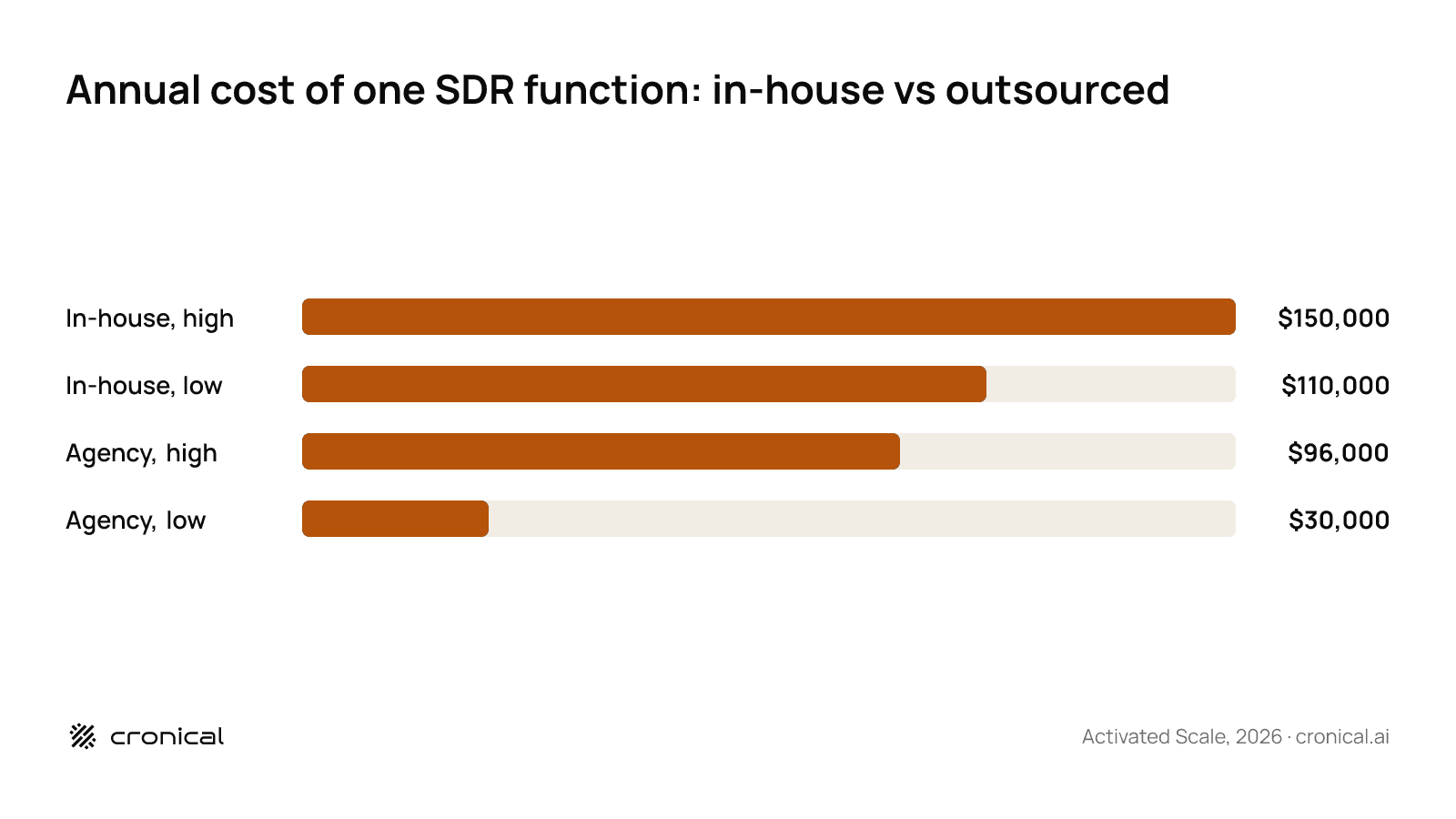
So why does anyone build in-house? Because the line items the chart cannot show are control, knowledge, and brand. Your own setter knows the product, hears the market daily, and answers to you. An agency rep on performance comp, working from a brief, mentions your company name dozens of times a day in conversations you will never hear. Results were sometimes there in the agency programs I ran. The control never was, and that is what made every result feel like a coin flip.
The third option did not exist when I started hiring agencies: keep the function in-house but let AI tooling do the volume work. The same strategies the agencies run, from list building and sequencing through follow-up and booking, are now available as software your own team operates.
| In-house SDR | Agency / outsourced | AI-assisted in-house | |
|---|---|---|---|
| Annual cost | $110K-150K per rep | $30K-96K per program | Software cost plus existing team time |
| Who talks to prospects | Your employee | A contractor, often offshore | Your team, at scale |
| Product knowledge | Deep, compounds over time | A one-page brief | Your team's own knowledge |
| Visibility into outreach | Full | Reports the vendor writes | Full |
| Time to pipeline | 4 to 6 months | 2 to 4 weeks | Days to weeks |
| Brand risk | Low, you control the message | High, strangers carry your name | Low, your words at scale |
| Scales by | Hiring more people | Paying for more meetings | Adding accounts, not headcount |
The agency wins on speed and entry price. In-house wins on knowledge and control. AI-assisted in-house is the attempt to keep both.
Here is the way I frame it after a decade of watching this trade-off: hiring an agency is hiring a stranger to represent your family. The better move is to rely on your family and give them the tools to represent themselves at scale. Everything in the comparison table is downstream of that one choice.
Sales appointment setting that actually books meetings
A booked meeting is not the product. A held meeting with a genuinely interested buyer is the product, and the gap between those two is where outsourced appointment setting quietly loses its economics. Average no-show rates for sales meetings sit at 20 to 35%, and the meetings most likely to evaporate are exactly the kind agencies produce: cold-sourced appointments show up around 40 to 50% of the time, against 60 to 70% for inbound MQLs and over 80% for referrals.
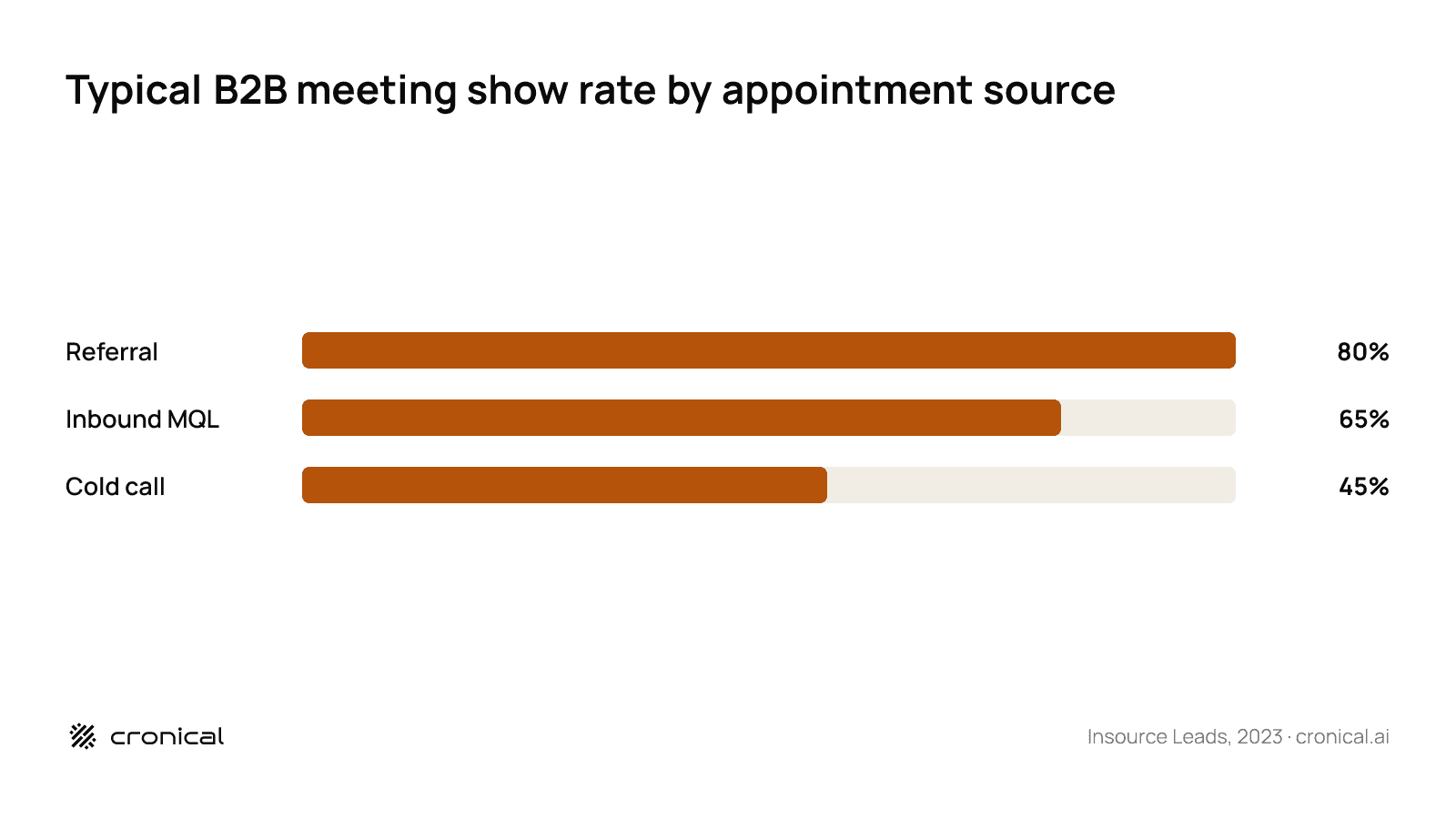
The mechanism behind those numbers is incentives, not laziness. Agency setters are typically on performance compensation, paid when the appointment books. So they push, hard, and a chunk of prospects agree to a meeting because agreeing is the fastest way to get off the phone. The appointment hits your calendar as "qualified." Nobody comes.
The meetings that do hold can carry a worse problem: misrepresentation. Inflated expectations are often the reason the meeting got booked at all, so your AE walks in already on the back foot, opening the call by deflating a promise they never made. I have watched reps spend the first ten minutes of a "hot" agency-set meeting apologizing. In a niche industry, where buyers compare notes, a few of those and you are known as the spray-and-pray company that blasts everyone and hopes. That reputation costs more than any per-appointment fee, and if you think the answer is simply more volume, cold outreach itself is not the problem; commoditized cold outreach is.
Quality of targeting beats quantity of sends inside the data too. Belkins found that reaching 1 to 2 well-chosen contacts per company pulls reply rates up to 7.8%, while blasting 10 or more people at the same company drops them to 3.8%. Tight targeting outperforms volume on its own terms.
Lead generation and appointment setting, together
Vendors sell lead generation and appointment setting services as separate line items. In practice they are one motion: pick the right companies, find the right people inside them, earn the conversation, book the meeting. Splitting that motion across two vendors is how you end up with a list vendor blaming a calling vendor for bad meetings while you pay both.
The teams that run this well treat it as a single account-based system. The target list is a list of companies, not emails. The outreach works several stakeholders in each company, because B2B deals are decided by buying committees, not individuals, and a meeting booked with the wrong person in the right account is still a miss. If you want the strategy layer underneath this, the account-based GTM framework is the longer treatment. The short version: appointment setting is the last step of account penetration, and it inherits all the quality of the steps before it.
The Meeting Yield Stack
After enough agency invoices, I started evaluating every appointment setting option, human or software, against the same four-layer model. I call it the Meeting Yield Stack, because each layer compounds into the next and the bottom line only works if the layers above it do.
How to evaluate any appointment setting model
The Meeting Yield Stack
- 01
Coverage
Of the companies you actually want, how many are being reached at all, and how many people inside each one? A thousand sends to the wrong accounts is zero coverage. Measure share of target accounts touched, not volume of activity.
- 02
Conversation
Of the accounts covered, how many turn into real two-way exchanges? This is where message quality and product knowledge live, and where offshore reps reading a brief lose to people who know the product.
- 03
Commitment
Of the conversations, how many become meetings that actually hold? Show rate is the truth serum here. A booked meeting from a pressured yes is inventory, not commitment.
- 04
Cost per held meeting
Total program cost divided by meetings that happened with qualified buyers. Not cost per booking. This single number makes every model, agency, in-house, or AI, directly comparable.
Run any vendor pitch through the stack and the questions write themselves. Which accounts will you cover and how deep? Who exactly is having the conversations? What is your show rate, not your booking rate? And what will my cost per held meeting be at month six? A $300 appointment with a 50% show rate is a $600 held meeting before you count your AE's wasted prep. The justified mathematics rarely survives that division.
How Cronical does appointment setting
Cronical is appointment setting without the stranger. It runs the full motion in-house for you: it works entire target companies rather than single contacts, finds the buying committee, and runs coordinated email and LinkedIn outreach in your words, under your visibility, so the people representing your company are your people, at scale. Some teams run it themselves; for others it operates as a managed motion where the system tosses the fishnet and hauls it in, and you take the fish: qualified meetings on your calendar. It optimizes the top of the Meeting Yield Stack, coverage of the accounts you chose, instead of charging you per pressured booking. See how it works and who it's for, or join the waitlist.
Before you sign an appointment setting contract
- Compute cost per held meeting, not per booked meeting, for every option you compare.
- Ask who specifically will run your outreach, where they sit, and how many other clients they carry.
- Get the vendor's show rate in writing, and make no-shows their cost, not yours.
- Demand raw visibility: actual sequences and replies, not a monthly summary.
- Cap the qualification criteria in the contract so 'qualified appointment' is not the vendor's word to define.
- Price the in-house AI-tooling route honestly before outsourcing; the gap is smaller than the agency deck says.
Frequently asked questions
What is B2B appointment setting?
B2B appointment setting is the process of contacting target prospects through calls, email, and social channels and converting interest into a scheduled meeting between a qualified lead and a closing sales rep. It can be done by an in-house SDR team, an outsourced agency, or software that runs the outreach motion for your own team.
How much do B2B appointment setting services cost?
Pay-per-appointment pricing typically runs $50 to $500 per appointment, with qualified B2B appointments averaging $350 to $700 in complex markets. Monthly retainers run roughly $3,000 to $10,000. A fully loaded in-house SDR costs $110,000 to $150,000 per year, so outsourcing usually wins on entry price but not necessarily on cost per held meeting.
Is outsourcing appointment setting worth it?
It can be, if you verify show rates and qualification quality rather than booking volume. The structural risks are real: offshore reps with thin product knowledge, performance compensation that rewards pushed bookings, no-show rates of 20 to 35%, and limited visibility into how your brand is represented. Compare every option on cost per held meeting before deciding.
What is the difference between lead generation and appointment setting?
Lead generation delivers contact data or expressions of interest that your team still has to work. Appointment setting delivers a booked meeting on a closer's calendar. Appointment setting costs more per unit because more of the conversion labor is included, but the two are really one motion, and splitting them across separate vendors usually hurts quality.
Can AI do B2B appointment setting?
Yes. AI tooling now handles the volume work of appointment setting: building account lists, finding stakeholders, writing and sequencing multichannel outreach, and booking meetings. The practical difference from an agency is that the outreach runs on your team's product knowledge with full visibility, instead of through contractors representing your brand from a brief.
Related reading
- Account-Based GTM: Framework, Benefits, and the Execution Gap
- B2B Buying Committees: How to Win the Whole Account
- Is Cold Outreach Dead? No, But Spray-and-Pray Is
More guides live in the resources library.