Two years ago this job did not have a name. Now there are over 3,000 open postings for it, the top ones pay a quarter of a million dollars, and half the founders I talk to are trying to hire one without quite being able to say what it is.
So here is the plain version. A GTM engineer is the person who builds the machine that runs your go-to-market. Not the strategy deck, not the cold calls, the machine: the data pipelines that find the right accounts, the logic that scores and routes them, the automations that fire outreach and update the CRM while everyone sleeps. They sit between the sales team and the software, and they write the glue.
The title was coined by Clay in 2023, when one early employee was running CRM, lead scoring, deal tracking and selling all at once and nobody had a box to put him in. It hit public job boards in early 2024. By April 2025 it had its own line on Google Trends. The work is older than the word, but the word is what made everyone suddenly want to hire it.
In This Post
- What a GTM engineer actually does
- Why the GTM engineer role exists now
- GTM engineer vs RevOps vs sales engineer
- The GTM engineer tech stack
- What GTM engineers get paid
- How to become a GTM engineer
- FAQ
What a GTM engineer actually does
Strip away the LinkedIn fog and the job is concrete. A GTM engineer takes a manual, repeated motion that the revenue team is doing by hand and turns it into a system that runs itself.
A few examples of the actual work:
- Building enrichment pipelines that pull firmographic and intent data, stitch it together, and surface the accounts worth touching this week.
- Writing the scoring and routing logic that decides which lead goes to which rep, or to no rep at all.
- Wiring buying signals (a funding round, a new hire, a competitor's logo appearing on someone's site) into a workflow that triggers the right play.
- Standing up the outbound machinery so personalized messages go out and replies get triaged without a human babysitting every step.
- Keeping the data underneath all of it clean, because a clever automation on top of garbage data just produces garbage faster.
The throughline is reuse. One person designs a workflow once, and it does the work of a small team forever. Florin Tatulea, GTM Engineer in Residence at ZoomInfo, draws the line cleanly:
Where Revenue Operations (RevOps) manages and optimizes what already exists, GTM engineering builds what's missing.
The one-sentence version
A GTM engineer is a builder, not a seller. The output is systems, not conversations. If the deliverable is a working pipeline that runs without them, that is the job.
Here is the loop in practice. A team hits a manual bottleneck. The GTM engineer decides whether it is a one-off pull or a repeatable system. If it is repeatable, they build it, ship it, measure whether it moved pipeline, and then templatize the winners for the next segment.
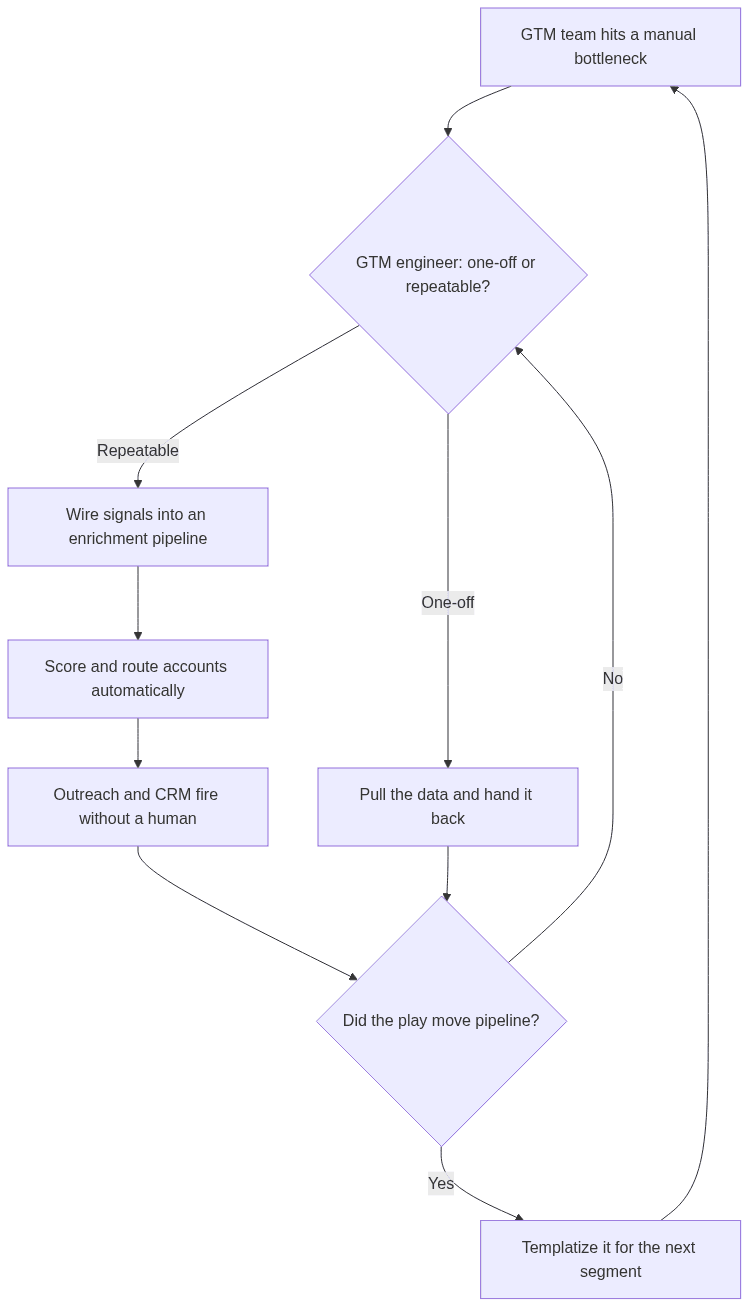
That measure-and-templatize step is what separates the role from "person who is good at Zapier." The job is not automating things. It is automating the things that move revenue and killing the ones that do not.
Why the GTM engineer role exists now
The honest answer is that selling got buried under non-selling work, and AI made it briefly possible to dig out.
Look at where a sales rep's week actually goes. According to Salesforce's State of Sales research, reps spend only about 30% of their time actually selling. The rest disappears into admin, data entry, internal meetings, and research.
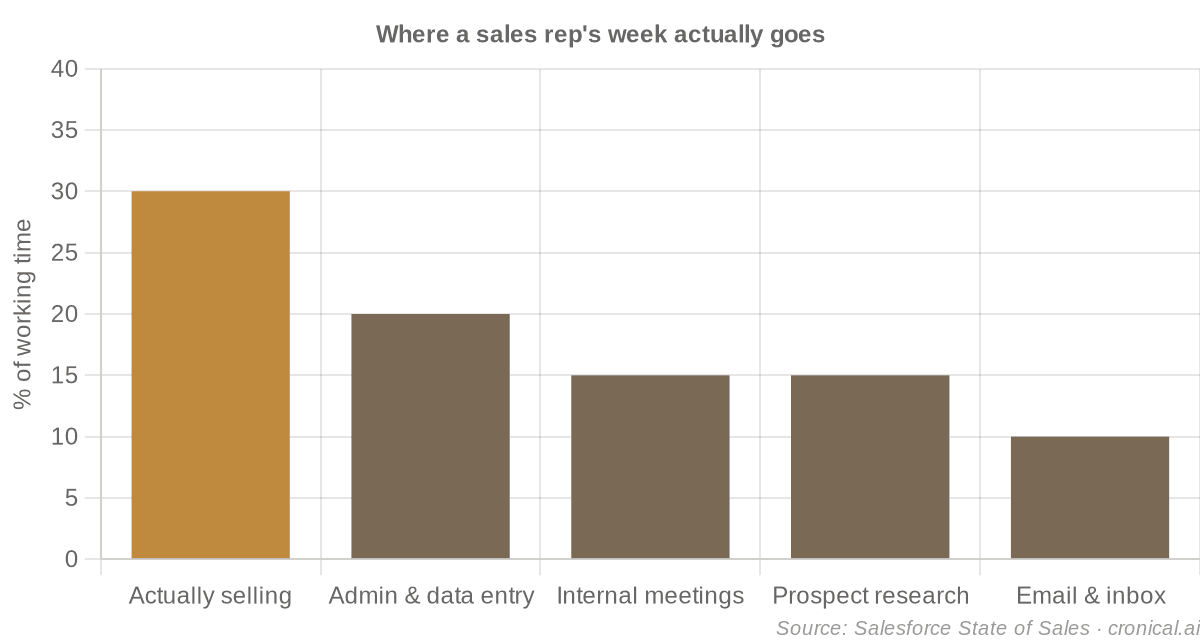
Source: Salesforce State of Sales
That 70% of non-selling work is exactly the surface a GTM engineer automates. The research, the routing, the data hygiene, the follow-up that never happens because a human got distracted. Marc Benioff, Salesforce's CEO, put the opportunity bluntly when talking to Fortune about AI agents in sales:
Thousands of leads, tens of thousands of leads, hundreds of thousands of leads have never been called back. But in the agentic world, there's no excuse for that. Every lead can be followed up on.
There is a catch, and it is a big one. Buying AI does not make the work disappear by itself. MIT's NANDA initiative analyzed enterprise AI deployments and found 95% of them produced zero measurable return, not because the models were bad, but because nobody integrated them into the actual workflow. That gap, between an AI tool and an AI tool that does useful work inside your revenue motion, is the GTM engineer's entire reason to exist.
The market responded the way markets do. GTM engineering job listings grew 205% from 2024 to 2025. Postings went from roughly 1,400 in the middle of 2025 to over 3,000 by January 2026. It is, by some counts, the fastest-growing role in B2B software.
A tool budget is not a strategy
Most teams that "invest in AI" buy six tools and wire none of them together. The 95% that see no return are not short on software. They are short on someone to make the software do the job.
GTM engineer vs RevOps vs sales engineer
The titles blur, so here is where the lines fall.
RevOps owns the systems that already exist. They keep Salesforce sane, run the reporting, manage the tech stack, and make sure the forecast adds up. Maintenance and optimization of a running machine.
A GTM engineer builds the parts of the machine that are not there yet. New enrichment waterfall, new scoring model, new signal-triggered play. Tatulea's other line for it: RevOps improves the output, GTM engineers build the machine. In practice the two overlap, and at a small company one person is often both.
A sales engineer is a different animal entirely, despite the shared word. Sales engineers are technical pre-sales: they sit on customer calls, run demos, and answer the hard product questions to help close a specific deal. A GTM engineer almost never talks to a prospect. The "engineer" in sales engineer points at the customer's problem. The "engineer" in GTM engineer points at your own revenue plumbing.
If reply rate and contact-level metrics are how your team keeps score, that is usually a sign the plumbing is the bottleneck. We wrote a whole piece on why account penetration rate is the metric that actually maps to pipeline, and building toward it is squarely GTM-engineering work.
The GTM engineer tech stack
There is no canonical toolchain, but the job postings cluster hard around a few categories. Someone analyzed 1,000 GTM engineering job listings and counted which tools showed up by name.
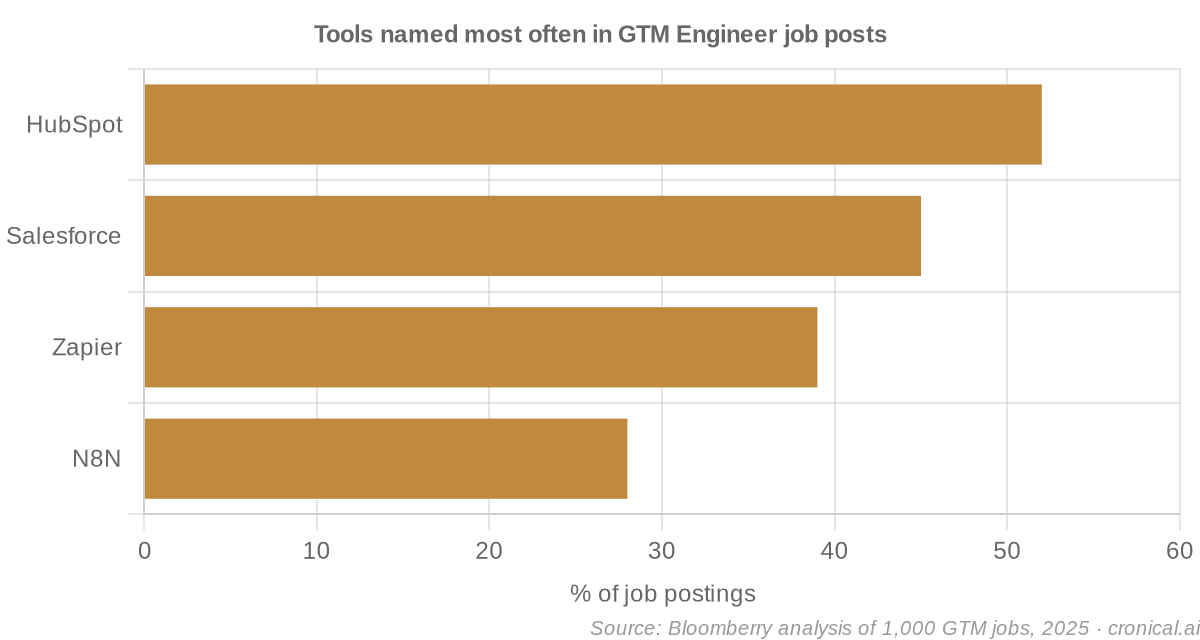
Source: Bloomberry analysis of 1,000 GTM jobs, 2025
Underneath the brand names, the categories matter more than any specific product:
- A CRM as the system of record. HubSpot showed up in 52% of postings, Salesforce in 45%.
- Workflow automation to connect everything. Zapier appeared in 39% of listings, n8n in 28%.
- Enrichment and signal data to feed the top of the pipeline.
- A scripting language. SQL and Python each appeared in about 38% of job postings. You do not need to be a software engineer, but you need to query a database and write a script without filing a ticket.
The skill that does not show up in a tool chart is judgment about data quality. As Tatulea warns, plenty of teams are "automating chaos rather than fixing the data underneath it." The tools are easy to buy. Knowing which workflow is worth building is the part that pays.
What GTM engineers get paid
The number that made everyone pay attention. The median GTM engineer salary sits around $127,500, but the median hides a wide spread. Postings range from roughly $132,000 to $241,000 depending on seniority and how technical the role is.
At the top, the comp looks like software engineering, because the work increasingly is. In the same 1,000-job study, the highest-paying employers were Vercel at $252,000, OpenAI at $250,000, and LILT AI at $221,500. The average role asked for about 4.1 years of experience, which tells you this is not an entry-level seat. Companies want someone who has already broken a few revenue systems and learned how to build them back.
Why pay that much for one person? The same reuse argument. One capable GTM engineer can support an organization up to $50 to $100 million in ARR by replacing manual motions with systems. Against a fully loaded sales team, a single builder who removes a chunk of the 70% non-selling drag is cheap.
The payback math
If a GTM engineer automates two hours of busywork a day across a ten-person sales team, that is twenty hours a day given back to selling. The salary stops looking expensive somewhere in the first quarter.
How to become a GTM engineer
The people landing these roles tend to come from one of two directions, and they meet in the middle.
The first group is RevOps and marketing ops people who got tired of waiting on engineering and learned to build. They already understood pipeline, ICP, and routing logic. They added SQL, an automation platform, and a little Python.
The second group is technical people, often growth engineers or analysts, who learned the revenue side. They could already script and query. They added an understanding of how deals actually get done.
If you are starting cold, a workable path:
- Learn the revenue model first. You cannot automate a motion you do not understand. Account penetration, ICP, lead scoring, attribution.
- Get fluent in one CRM and one automation tool deeply, rather than five shallowly.
- Learn enough SQL to answer your own data questions and enough Python or JavaScript to glue two APIs together.
- Build something real. The portfolio for this job is a workflow you shipped that moved a number, not a certificate.
The unglamorous truth is that the role rewards people who like plumbing. The satisfaction is in a system that quietly works, not in a deck or a closed deal you can point at.
This is the same instinct that built Cronical. Account-first outreach that works the whole company instead of blasting one contact is exactly the kind of repeatable, account-level system a GTM engineer would otherwise have to wire together by hand. If you think in accounts and pipeline rather than open rates, join the waitlist.
FAQ
What is a GTM engineer in simple terms?
A GTM engineer builds the automated systems that run a company's go-to-market: the data pipelines, scoring logic, routing, and outreach automation that turn revenue strategy into something that runs on its own. They are builders who sit between the sales team and the software, not sellers who talk to customers.
Is a GTM engineer the same as RevOps?
No, though they overlap. RevOps maintains and optimizes the revenue systems that already exist. A GTM engineer builds the systems that are missing. At a small company one person often does both; at scale they are distinct functions.
Do you need to know how to code to be a GTM engineer?
You need to be technical, but not a full software engineer. SQL and Python each show up in about 38% of job postings. The practical bar is being able to query a database, write a script to connect two tools, and reason about data quality without filing an engineering ticket.
How much does a GTM engineer make?
The median sits around $127,500, with most postings between $132,000 and $241,000. The most technical roles at top companies pay like software engineering jobs: Vercel, OpenAI, and LILT AI have all posted GTM engineering roles above $220,000.
Why did the GTM engineer role appear now?
Two forces collided. Sales reps were spending only 30% of their time selling, and AI tools suddenly made it possible to automate much of the other 70%. But the tools do not integrate themselves, and 95% of enterprise AI pilots show no return without someone to wire them into the actual workflow. That someone is the GTM engineer.